InvestorBase Review: Pricing and a Dispo Test
An InvestorBase review from a wholesaler who wired it into an AI dispo agent: what the buyer data does, what it costs, and the deal it closed at $150K.
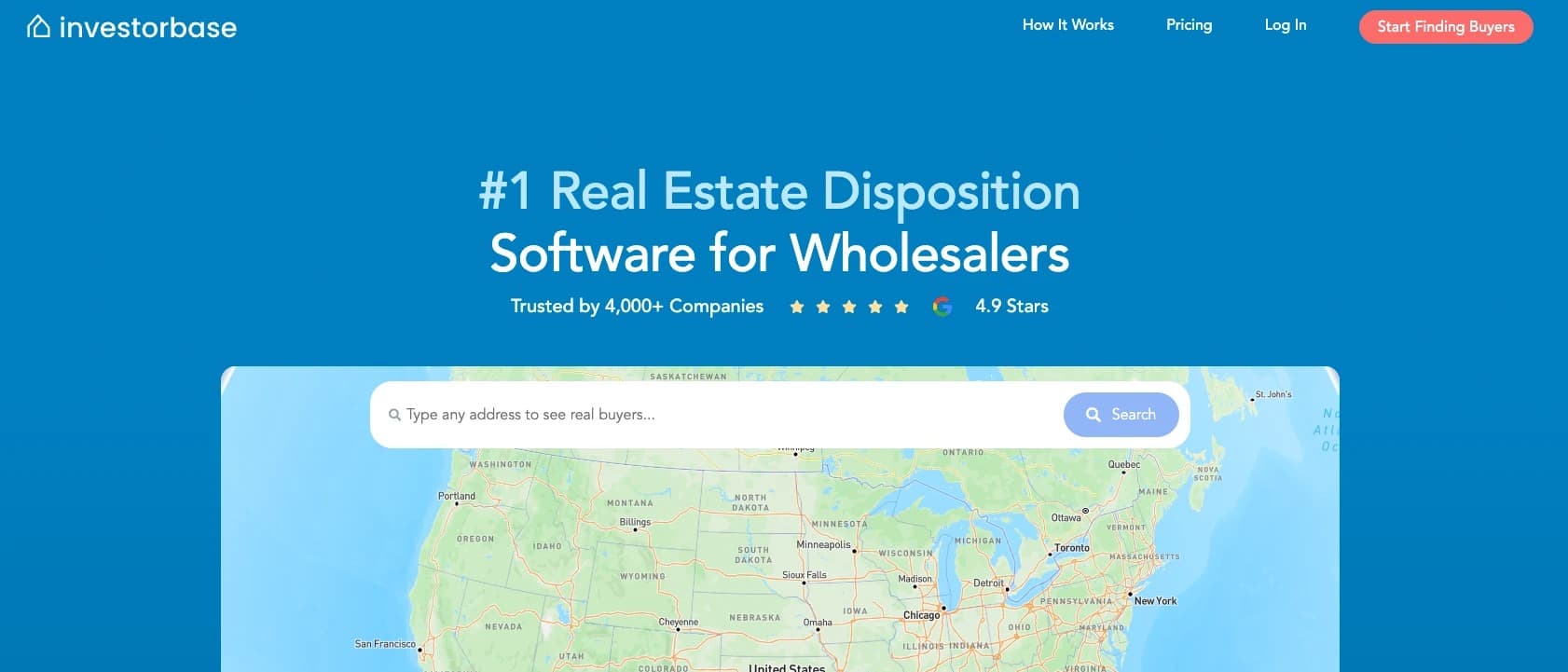
InvestorBase is disposition software for wholesalers. You type in an address, and it ranks the cash buyers most likely to want that house, based on what they have already bought nearby. Pricing in October 2026 runs $199 a month billed annually, $249 a month billed quarterly, or $299 month to month, with a 14-day free trial. If you are selling more than a deal or two a month and you are still working a buyer list you built by hand, it pays for itself on one assignment.
I did not come to it as a reviewer. I came to it while prototyping an AI dispo agent, and the thing I wanted was an address-to-buyer-list API I did not have to build. That test is the most useful part of this review, so I will start there.
Start a free InvestorBase trial if you want to follow along in the product.
The test: one address, 15 buyers, a $50K spread
I was building a dispo agent as a prototype. I connected it to InvestorBase, connected it to my iMessage, and gave it one job: take an address, find the buyers who fit it, and text them.
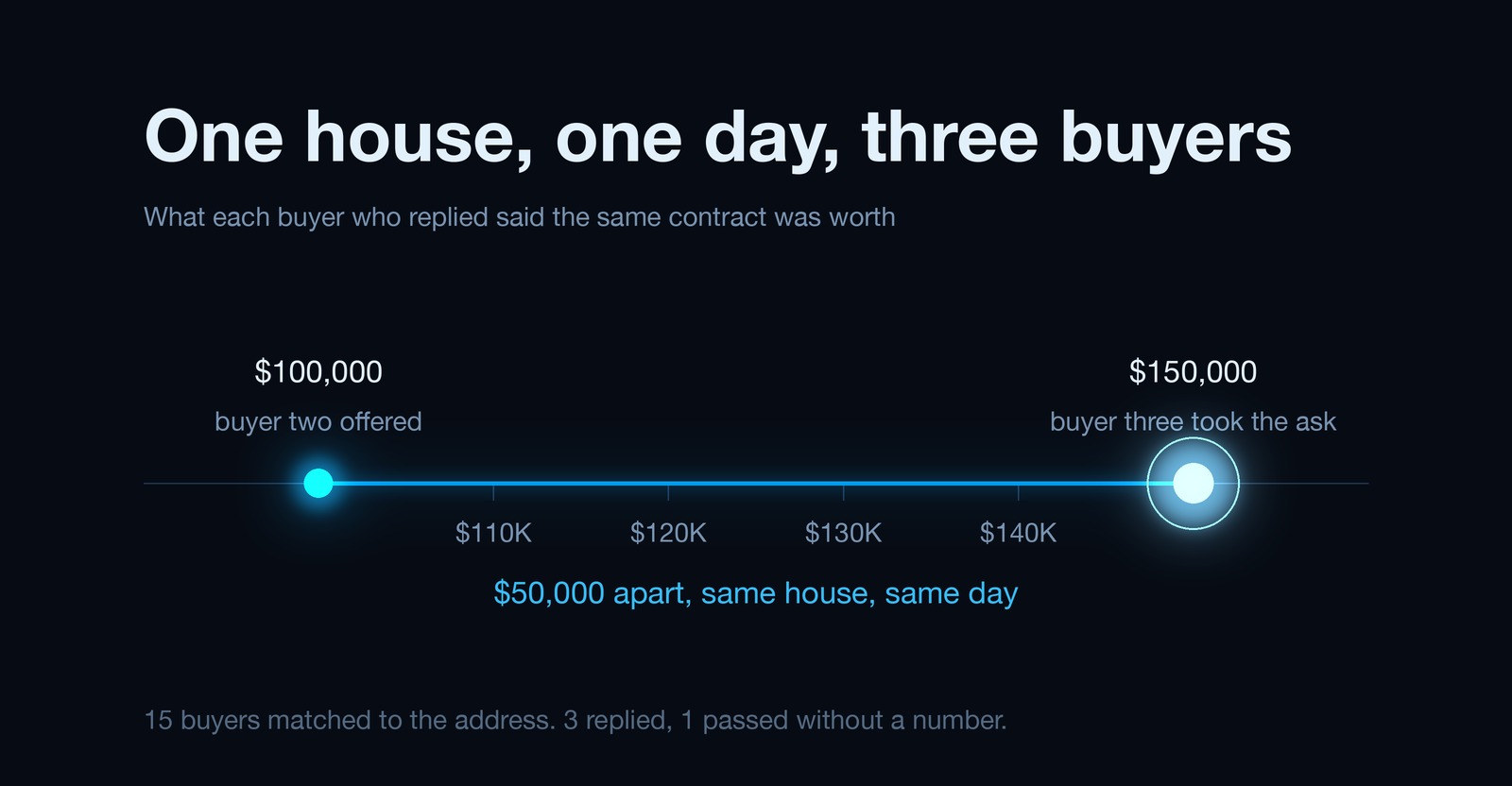
My ask on the deal was $150,000. The offers I had been getting on my own, before any of this, were landing around $100,000.
The agent ran the search and came back with 15 buyers. It texted all 15. Three replied. One was not interested, one offered $100,000, and one took the $150,000 ask. We closed at $150,000.
A 3-in-15 reply rate is not remarkable, and I am not going to pretend it is. What mattered was the spread. The same house drew $100,000 from one buyer and $150,000 from another on the same day. I did not negotiate my way to the extra $50,000. I just reached the buyer who valued the house at $150,000 instead of stopping at the first one who answered, and the only reason I reached 15 buyers at once is that pulling and contacting them cost me no time.
That is the honest case for software like this. It does not get you a better price out of a given buyer. It gets you more of the right buyers in front of the deal while the deal is still fresh, and the price is whatever the best of them says.
What InvestorBase actually does
The product is organized around the address, not the list. You search a property and get ranked buyers instead of a database to filter.
Buyer Search and AI SmartMatch is the core: enter an address, get buyers ordered by fit, nationwide. The company's own numbers for what sits behind the ranking do not agree with each other: the homepage advertises over 50 million transactions and 10 million buyers, while the How It Works page puts it at 6,241,625 investor transactions, both checked in October 2026. The ranking worked on my deal, so I am not making much of it, but it is a fair thing to ask on a demo.
Skiptracing is included at no extra charge, inside the product, which is unusual. On most stacks that is a separate vendor and a separate per-record bill.
Linked Deals and Buyer Portfolios show you a buyer's flip and rental history. This is the part I use most for sanity, because a buyer's last six purchases tell you their real buy box faster than any conversation will.
There is also a dispo CRM and buyers list for status, notes and activity, mobile landing pages for sharing a deal and tracking the offers that come back, and investor and retail comps that generate ARVs and calculate MAOs. The site lists CRM, SMS and dialer integrations so you can work without leaving the app.
What you can automate, and what you cannot
This is the part I had to work out the hard way, and it is the thing I would want to know before paying.
The integrations tab inside your account issues an API key and connects the Zapier app. The key is the part I cannot help you with: InvestorBase publishes no endpoint documentation to go with it, so what it opens, and whether it does more than authorize the Zapier connection, is a question for their support before you plan any build around it.
What is documented is the Zapier app: five triggers and one action. The shape of that list tells you most of what you need to know. An agent can reach those same six operations through Zapier's own MCP server, which exposes everything in Zapier's directory. That is Zapier's doing, not an MCP server InvestorBase ships, and the distinction matters if you are choosing tools by how directly an agent can drive them.
The action is the good part. Adding a buyer to your buyers list takes name, email, phone and address, and then the buy box itself: minimum and maximum purchase price, maximum renovation budget, oldest year built, property types from single family through land and mobile homes, flipper or landlord, VIP, and a "doesn't buy" list covering septic, well water, pools, HOAs, multi lane roads and commercial adjacency. That is a structured buy box you can write to from anywhere. If you are serious about the advice further down about recording what every buyer wants, this is the endpoint that makes it stick, and it is the one I would wire up first.
The triggers are where the limit shows. All five fire from something a human does in the product: clicking "Send to Zapier" on a buyer, on several buyers, or on the buyers page, plus an offer coming in through one of your listings. They push data out when you press a button. None of them lets you ask a question.
So there is no documented public endpoint for the thing the product is actually best at, which is "give me the ranked buyers for this address." You can write buyers in and you can push buyers out, but the search itself stays inside the app. That is why my agent drove the product rather than an API, and it is the single change that would make this tool a building block instead of a destination.
The pitch on their homepage is reverse wholesaling: find the buyers first, then go get them a house. That is a real strategy and the data supports it, though in practice most people will use it the way I did, with a contract already signed and a clock running.
What InvestorBase costs
Prices from the InvestorBase pricing page, checked October 2026:
| Billing | Price | Billed as |
|---|---|---|
| Annual | $199/mo | $2,388 up front, advertised as 4 months free |
| Quarterly | $249/mo | $747 every 3 months |
| Monthly | $299/mo | $299/mo |
Every plan includes the 10 million buyer database, free skiptracing and nationwide access. The page does not publish seat counts, credit limits or market limits, so ask about those on the demo if you have a team. The signup section says 14-day free trial, cancel anytime.
Against an assignment fee, $299 is not the number to agonize over. Start month to month, run it on live deals for a month, and only move to annual once you know your team will open it every day.
How to get results with it instead of just owning it
The tool ranks buyers. Everything that decides whether you collect a fee happens after that.
Ask for a number before you have made your case. My $50,000 spread existed because I let buyers price the house instead of leading with my ask and negotiating down from it. The first buyer to answer is a data point, not the market.
Check the portfolio before you trust the match. A ranked list is a prediction. Two minutes in a buyer's purchase history tells you whether they buy that zip, that price band and that level of rehab, or whether they bought one house there in 2023.
Write down the buy box, every time. The buyers worth having are the ones you can text about a specific house eight months from now without looking anything up. This is the asset the software cannot build for you, and it is the one that survives a subscription cancellation.
Send to the fit, not to the whole list. Blasting 500 people teaches them to ignore you. Fifteen buyers who each plausibly want that house is a different message with a different reply rate.
Have a second buyer ready. Buyers fall out. The time to line up the backup is while the first one is still saying yes.
If you want the full process this sits inside, I wrote it up separately: how dispositions work in real estate wholesaling, and how to find buyers for wholesale real estate covers building a list from county records so you are not renting your entire buyer side.
Before you automate the texting
The part of my prototype that sent messages is the part I would not hand to a client as it stood. Texting buyers one at a time from your own phone is a conversation. Texting at volume from an application is marketing traffic, and the carriers treat it that way: you need a registered 10DLC campaign, consent that matches what you are sending, and an opt-out that works. I covered the registration and the fees in A2P 10DLC registration.
A buyer list is also not a cold list. These are people who asked to hear about deals, which is a much better position to be in than seller outreach, and it is worth keeping clean rather than burning for one extra send.
The agent itself is the easy half. Search, rank, draft, send, log the reply. Ours ran on an evening of work. The compliance and the follow-up are what take real building, which is what we do at White Space when a wholesaler wants this running as a system instead of a demo.
InvestorBase or InvestorLift
They solve different halves of the same problem. InvestorLift is a marketplace: you post a deal and its buyer network sees it, which is reach you do not have to earn. InvestorBase is data and workflow: it tells you which specific buyers in your market fit this house, and the relationship stays yours.
If you have no buyers, a marketplace gets you liquidity fastest and takes a cut of the upside for it. If you are trying to own your buyer side, InvestorBase is the one that compounds, because every deal you run through it adds buy boxes to a list you keep.
I would rather own the list. That is a preference, and it costs more effort up front.
Is it worth it
For a wholesaler closing two or more deals a month in a market with real investor activity, yes, and the decision is not close. One assignment covers a year of it.
For someone who has not closed a deal yet, no. Buyer data is not the constraint at that stage; finding a seller who will sign is, and a $249 subscription that sits unopened is the most common way new wholesalers spend money on momentum they do not have.
For a team: the thing to confirm on the trial is seats and whether the dispo CRM is good enough to replace what you use now, because running buyer status in two places is worse than running it in the weaker one.
Start the 14-day trial and run it against three addresses you have already sold. If the buyers it surfaces are the ones who actually made offers, you know it works in your market. If it misses them, you know that too, inside the trial and before you pay.
Questions people ask
How much does InvestorBase cost? $199 a month billed annually ($2,388), $249 a month billed quarterly ($747 per quarter), or $299 month to month, as published in October 2026. Skiptracing and nationwide access are included on every plan.
Is InvestorBase good? It is good at the one thing it is built for: turning an address into a ranked list of buyers who have bought comparable houses nearby. It will not negotiate, qualify or follow up for you, and the buyer list you build out of it is worth more than the subscription.
Does InvestorBase have an API? Your account's integrations tab issues an API key, but there is no public endpoint documentation to go with it, so ask their support what it covers. The documented surface is the Zapier app: five triggers and one action. You can add a buyer with a full buy box, and you can push buyers and incoming offers out of the app. You cannot query it for the buyers who match an address, which is the automation most dispo teams would want.
Does InvestorBase have an MCP server? Not one of its own. You can reach its Zapier operations through Zapier's MCP server, because that covers everything in Zapier's directory, so an agent gets the same six operations and no more.
Is it the same as InvestorLift? No. InvestorLift is a buyer marketplace that gives you reach into its network. InvestorBase gives you buyer data and a dispo workflow for your own market, and you keep the relationships.
Founder & CEO, White Space Solutions
Jason builds AI automation systems for real estate investors and business owners. With experience spanning data analytics, direct mail automation, AI voice agents, and revenue intelligence, he helps companies replace manual workflows with intelligent systems that drive measurable results.
Related Articles
Dispositions in Real Estate Wholesaling
What dispositions means in real estate wholesaling, how to run dispo from buyer list to assignment, the legal lines, and where software and AI help.
How to Find Buyers for Wholesale Real Estate
How to find buyers for wholesale real estate: pull recent cash purchases, work REIAs and lenders, qualify buy boxes, and when InvestorLift is worth it.
How to Wholesale Real Estate, Step by Step
How to wholesale real estate in 8 steps: state rules, buyers, sellers, the offer math, the contract and closing, plus where AI saves the most time.
REIkit Review: Pricing, Features, Alternatives
What REIkit is, what its three plans include and cost, where it falls short for teams, and the alternatives wholesalers compare it with.