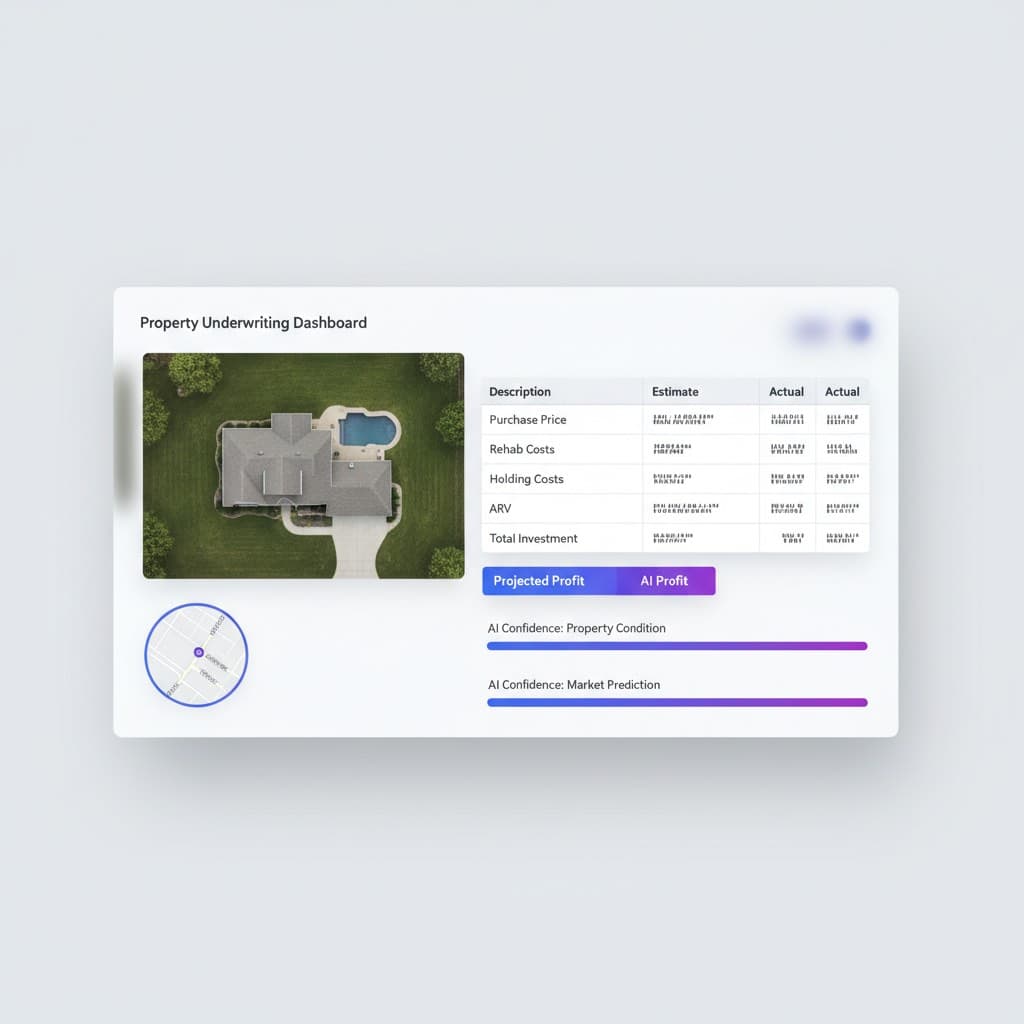
AI Property Analysis & Underwriting
How AI property analysis cuts underwriting from hours to minutes. Real pipeline diagram, tool comparison, and a sample deal analyzed end-to-end.
The first time I watched an acquisitions manager underwrite a single-family flip, it took him 47 minutes. He pulled comps from Zillow, cross-checked them in PropStream, called a contractor for a rough rehab number, plugged everything into a spreadsheet, then re-ran the math twice because the ARV felt high. Multiply that by 30 leads a day and you understand why most wholesalers only seriously underwrite the top 10% of what comes in.
That bottleneck is exactly where AI property analysis earns its keep. AI property analysis isn't a luxury anymore, it's how you stay competitive when the next investor down the street is reviewing every lead in under five minutes. I've spent the last 18 months rebuilding underwriting pipelines for real estate investors, wholesalers doing 5 deals a month, fix-and-flip operators running 40 projects a year, and a small fund with $40M deployed. In every case, the win wasn't replacing the human underwriter. It was compressing the first 80% of the work into 90 seconds so the human could focus on the 20% that actually moves a deal.
This guide walks through how I build those pipelines. You'll get the architecture, the tool stack I actually use for AI property analysis (not a generic listicle), a sample deal analyzed end-to-end, and the trade-offs nobody mentions until you're three months in. If you'd rather skip the build and have us deploy it for your team, our AI agency for real estate investors ships this exact stack in 30 days.
What AI property analysis actually means
The phrase "AI property analysis" gets tossed around loosely, so let's pin it down. AI property analysis is the use of machine learning models, LLMs, and orchestrated data pipelines to ingest a property address and output a defensible underwriting opinion, ARV, repair estimate, exit strategy fit, and risk flags, without a human touching a spreadsheet. Real AI property analysis is the full pipeline, not any single tool.
It is not:
- A single ChatGPT prompt that "values" a house (those hallucinate ARV by 18-35% on real comps I've tested)
- An AVM in isolation (Zillow's Zestimate has a 7.5% national median error per their own published data - fine for a starting point, useless as a final number)
- Generic Excel automation with
=VLOOKUPand a coat of paint
Done right, ai underwriting real estate combines four layers: a comp engine (AVM + MLS), a condition model (computer vision on photos), a rehab estimator (line-item GPT with contractor pricing), and a strategy router (does this deal pencil as a flip, rental, or wholesale?). The orchestration layer, usually n8n, Temporal, or a custom Python service, is what makes it production-grade.
The AI property analysis pipeline I deploy
Here's the AI property analysis architecture I land on for most clients. It's framework-agnostic so you can build it in n8n, Make, Python, or whatever your team can maintain.
┌─────────────────────────────────────────────────────────────┐
│  TRIGGER: New lead (CRM webhook, Zapier, manual upload)     │
└──────────────────────────┬──────────────────────────────────┘
                           │
                           ▼
┌─────────────────────────────────────────────────────────────┐
│  1. DATA ENRICHMENT                                         │
│     • Address validation (Google Maps Geocoding)            │
│     • Parcel + tax data (Regrid, ATTOM, PropMix)            │
│     • Owner skip trace (BatchSkipTracing, IDI)              │
│     • Photo ingestion (MLS, Zillow scrape, seller upload)   │
└──────────────────────────┬──────────────────────────────────┘
                           │
                           ▼
┌─────────────────────────────────────────────────────────────┐
│  2. COMP ENGINE                                             │
│     • Pull 25 to 50 sold comps within 0.5mi, 12 months         │
│     • Filter by sqft ±20%, beds/baths match, same school    │
│     • AVM ensemble: HouseCanary + Zillow API + custom model │
│     • Output: ARV range (low / median / high)               │
└──────────────────────────┬──────────────────────────────────┘
                           │
                           ▼
┌─────────────────────────────────────────────────────────────┐
│  3. CONDITION + REHAB MODEL                                 │
│     • Vision model classifies each photo                    │
│       (kitchen condition, roof age, foundation cracks)      │
│     • GPT-4 generates SOW with line items                   │
│     • Multiply by zip-level contractor pricing              │
│     • Output: Rehab range (light / medium / heavy)          │
└──────────────────────────┬──────────────────────────────────┘
                           │
                           ▼
┌─────────────────────────────────────────────────────────────┐
│  4. STRATEGY ROUTER                                         │
│     • Flip math: MAO = (ARV × 0.70) − Rehab                 │
│     • Rental math: cap rate, DSCR, cash-on-cash             │
│     • Wholesale math: assignment fee feasibility            │
│     • Output: Best-fit strategy + confidence score          │
└──────────────────────────┬──────────────────────────────────┘
                           │
                           ▼
┌─────────────────────────────────────────────────────────────┐
│  5. HUMAN-IN-THE-LOOP REVIEW                                │
│     • Slack/CRM card with summary + comps + photos          │
│     • Underwriter approves, edits, or kills                 │
│     • Decision logged back to data warehouse for retraining │
└─────────────────────────────────────────────────────────────┘
Notice step 5. I never ship this without it. The point isn't to remove the underwriter - it's to hand them a 90-second decision instead of a 47-minute one.
AI property analysis tool comparison: what I actually use
I get asked weekly which AI property analysis tools to pick. The honest answer is "it depends on your volume and your data discipline." Here's how the realistic options stack up.
| Layer | Tool | Strength | Weakness | Cost (rough) |
|---|---|---|---|---|
| AVM | HouseCanary | Best institutional accuracy, confidence scores included | Pricey at scale | $0.50 to $2.00 / call |
| AVM | Zillow API (via partner) | Free-ish, broad coverage | Zestimate error band is wide | Variable |
| AVM | ATTOM | Good national coverage, includes tax + parcel | Latency, occasional staleness | Enterprise |
| Parcel/Tax | Regrid | Cheapest nationwide parcel | Updates lag in some counties | $0.01 to $0.05 / parcel |
| Comps/MLS | PropStream | Investor-friendly UI, RVM | API access requires negotiation | $99/mo + |
| Comps/MLS | Direct MLS via RETS/RESO | Most accurate, real-time | Per-market setup hell | Varies by board |
| Vision | OpenAI GPT-4o vision | Best general scene understanding | Not real-estate-trained | $0.01 to $0.03 / image |
| Vision | Restb.ai | Purpose-built for property photos | API quotas, less flexibility | Enterprise |
| Rehab | Custom GPT-4 + zip pricing | Tunable, explainable | Requires your pricing library | LLM tokens only |
| Rehab | Kukun / RenoFi APIs | Pre-built rehab estimates | Generic, not local-cost aware | Per-call |
| Orchestration | n8n (self-hosted) | Cheap, visual, full code escape hatch | You maintain it | $15 to $50/mo VPS |
| Orchestration | Temporal | Bulletproof for high volume | Engineering-heavy | Dev time |
| Data warehouse | BigQuery | Cheap, fast, ML-friendly | Setup learning curve | ~$5 to $50/mo at investor scale |
For most teams doing 20 to 500 leads/day, my default AI property analysis stack is: Regrid + HouseCanary + GPT-4o vision + custom rehab prompt + n8n + BigQuery. Total tooling cost for the full AI property analysis stack lands around $400 to $1,200/month depending on volume, and a single saved deal pays for a year of it.
The data warehouse piece matters more than people realize - you want every analyzed property and every underwriter override flowing into BigQuery so you can measure model drift. I wrote about the pattern in detail in Claude Code as a data engineer agent piping Customer.io into BigQuery; the same pipeline shape works here.
Sample AI property analysis: 4218 Elm St (anonymized)
Let me walk through a real AI property analysis we ran last quarter. Numbers are rounded to ranges to protect the seller, but the structure is verbatim.
Subject: 3 bed / 2 bath, 1,420 sqft single-family in a Tier-2 Sunbelt metro, built 1968. Seller called the inbound line at 9:14 AM. Pipeline triggered automatically when the rep tagged the lead "qualified" in the CRM.
Step 1: Enrichment (8 seconds)
- Address validated, geocoded to parcel
- Tax assessor value: ~$165K (TODO: insert exact range from your county data)
- Lot size: 0.21 acres
- Last sale: 2003, $74K
- 11 MLS photos pulled, 6 seller-uploaded photos added
Step 2: Comp engine (24 seconds)
Pulled 38 sold comps, 0.4-mile radius, last 9 months. Filtered to 14 after sqft/beds/school match. HouseCanary RVM returned:
- ARV low: $245K to $255K range
- ARV median: $268K to $278K range
- ARV high: $290K to $300K range
- Confidence score: 0.82 (high)
Step 3: Condition + rehab (47 seconds)
Vision model flagged:
- Kitchen: "dated, oak cabinets, laminate counters" → full reno
- Bath 1: "functional, needs vanity + tile" → light reno
- Bath 2: "needs full gut" → full reno
- Roof: "3-tab shingles, visible curling" → replace
- HVAC: visible exterior unit, estimated 12+ years → replace
- Flooring: carpet throughout, "stained" → LVP throughout
GPT generated a 23-line SOW. Zip-level pricing produced:
- Rehab light: $38K to $44K range
- Rehab medium: $52K to $58K range (selected as base case)
- Rehab heavy: $68K to $78K range
Step 4: Strategy router (3 seconds)
Flip math (base case):
  MAO = (ARV median × 0.70) − Rehab medium − $8K closing
      = ($273K × 0.70) − $55K − $8K
      = $191K − $55K − $8K
      = $128K range

Rental math (base case):
  Estimated rent: $1,950 to $2,100/mo (rentometer)
  ARV all-in (purchase + rehab + closing): ~$255K
  Cash-on-cash at 20% down: ~6.1% (TODO: confirm with current rates)

Wholesale math:
  Assignment ceiling at $128K MAO − $8K fee = $120K offer
Router output: Flip-fit with a $128K MAO, wholesale-fit at $120K offer with $8K assignment. Confidence 0.78. Strategy router flagged it "PRIORITY - call before 5 PM."
Step 5: Human review (90 seconds)
Underwriter saw the Slack card, opened two comps that looked aggressive, agreed with the rehab range, adjusted MAO down $4K for HOA risk the model missed, and approved a $116K wholesale offer. Total elapsed time from lead-in to greenlit offer: under 4 minutes.
The same deal pre-pipeline would have taken that team 35 to 50 minutes and probably wouldn't have been touched until end-of-day.
Where AI property analysis still gets it wrong
I'd be lying if I said AI property analysis is plug-and-play. Three failure modes show up in every AI property analysis deployment.
1. Photo deception. Sellers send the three good photos. The vision model says "light cosmetic" and your rehab number is $25K low. Fix: require a video walkthrough or use Restb.ai's photo-completeness score to flag thin coverage.
2. Off-market comp drift. AVMs lean on MLS-sold data. In wholesale-heavy markets where 30%+ of transactions are off-market and not in MLS, your ARV can be systematically high. Fix: layer in your own closed-deal data, and discount AVM output by a market-specific factor (we typically apply 3 to 7% in heavy-wholesale metros).
3. Strategy router overconfidence. The math is only as good as the inputs. A 70% rule that worked in 2021 is too loose in 2026 with current rates. Fix: parameterize your buy box per market and refresh it monthly from your own closed-deal warehouse.
This is the part of automated property analysis that nobody sells you on the demo. The model is the easy 60% of AI property analysis. The data pipeline, the feedback loop, and the per-market tuning are the other 40% - and that's where the real AI property analysis value lives.
How AI property analysis connects to the rest of your lead flow
AI property analysis doesn't live in isolation. The pipeline above is the third stage in a four-stage system I deploy:
- Lead generation - paid + outbound + SEO feeding the CRM. Our AI lead generation for real estate breakdown covers the inbound side.
- Qualification - AI voice receptionist or chat agent that filters tire-kickers before they hit a human.
- Underwriting - this post.
- Decision intelligence - closed-deal data flowing back into BigQuery for buy-box tuning and model retraining. We treat this as a data insights engagement, and it's the multiplier on everything else.
Skip stage 4 and your real estate ai valuation quality plateaus inside six months. The teams that win are the ones treating AI property analysis as a data product, not a one-time integration.
What to build first if you're starting AI property analysis from zero
If you're a 1 to 5 person investor team staring at this AI property analysis stack and feeling overwhelmed, start small:
- Week 1: Get a Regrid + HouseCanary trial. Pipe one lead/day manually through Postman and see if the ARV matches your gut.
- Week 2: Stand up n8n on a $15 DigitalOcean droplet. Build the enrichment + comp engine steps only. Skip the vision model for now.
- Week 3: Add a Slack notification with comp summary. Have your team rate each output thumbs up/down. That's your training signal.
- Week 4: Add the rehab model. Use GPT-4o vision with a 6-shot prompt of your own past rehab quotes as examples.
- Month 2: Migrate logs to BigQuery. Now you can measure error rates and improve.
You don't need a $40K consulting engagement to get the first 70% of AI property analysis value. You need 30 hours of focused build time and a willingness to be wrong for the first two weeks. If you want a partner that's done this 20+ times and can compress the timeline to 30 days, that's literally what our AI agency for real estate investors does.
The bottom line on AI property analysis and AI deal analysis
AI property analysis and ai deal analysis aren't a 2026 fad, and they're not going to replace good underwriters. What AI property analysis does is reset the economics of how much you can underwrite per dollar of payroll. A team that used to seriously look at 10% of inbound leads can now run AI property analysis on 100% of them, with the underwriter spending their time on judgment calls instead of pulling comps.
The AI property analysis build is straightforward. The hard part is the data discipline behind it - and that's the part most "AI for real estate" pitches conveniently leave out.
If you're ready to deploy a production pipeline instead of stitching together demos, book a 30-minute scoping call and we'll map AI property analysis to your exact deal flow.
Founder & CEO, White Space Solutions
Jason builds AI automation systems for real estate investors and business owners. With experience spanning data analytics, direct mail automation, AI voice agents, and revenue intelligence, he helps companies replace manual workflows with intelligent systems that drive measurable results.
Related Articles
AI Agency for Real Estate: Buyer's Guide
How to evaluate an AI agency for real estate investing: engagement models, pricing benchmarks, red flags, and the exact questions to ask before signing.
Run Your Wholesaling Business With 3 AI Agents
How to run a real estate wholesaling business with 3 AI agents - Acquisitions, Dispo, and Ops. Daily output, cost, and the scale path I use with clients.
VA to AI Migration: 12-Month Guide
A month-by-month VA to AI migration playbook for real estate investors. Cost curves, change management, and lessons from rebuilding our team from scratch.
The AI Command Center for Investors
Build an AI command center for real estate investors. Our metric framework, reporting stack (BigQuery, Plecto), and build vs buy decision tree.