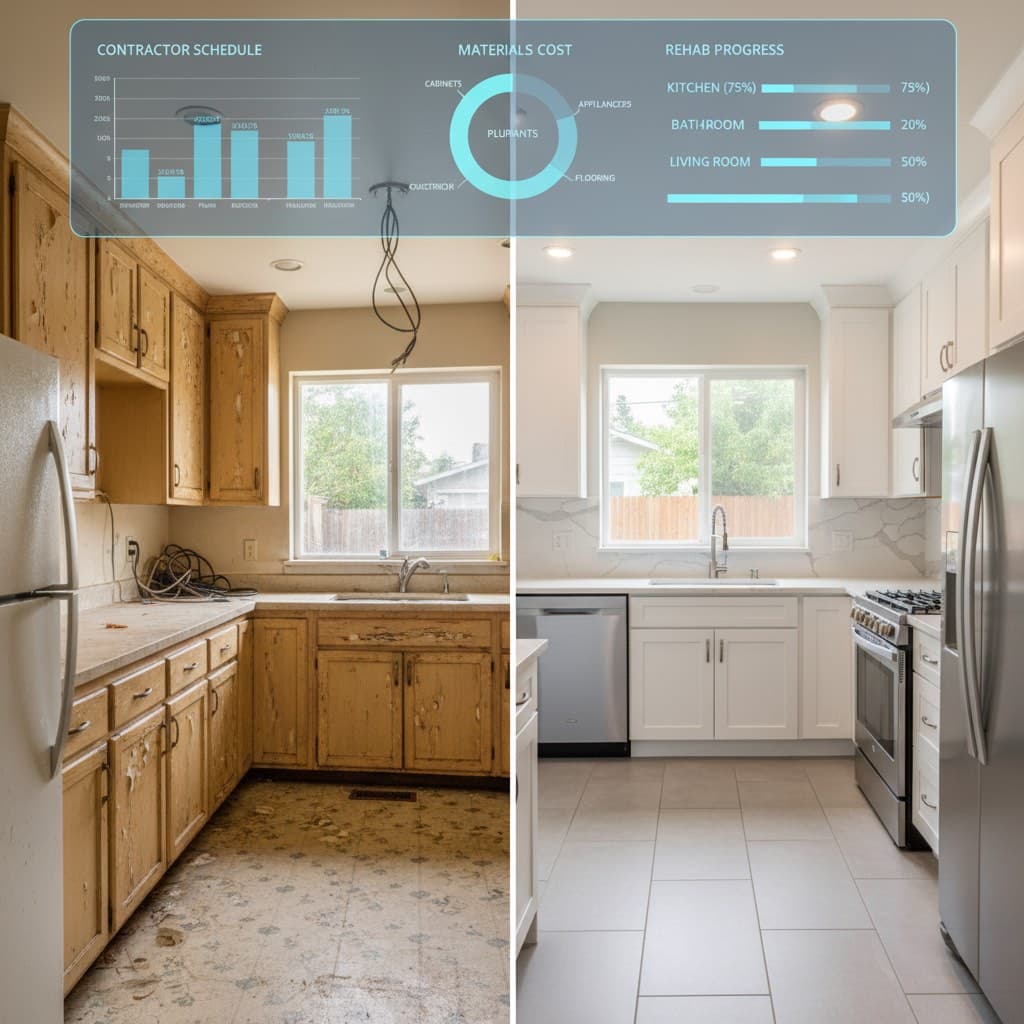
AI for House Flippers: 7 Workflows
AI for house flippers: 7 plug-and-play workflows for deal sourcing, rehab, contractors, and dispo that save 10+ hours per week. Templates and tools inside.
I flipped my first house in 2019 and spent more time chasing contractors and sorting receipts than I did finding deals. The math never made sense to me. I was running a six-figure construction project from a clipboard and a group text thread.
Five years and a lot of broken spreadsheets later, AI for house flippers is no longer a nice-to-have. It's the difference between running two flips a year and running ten without hiring a project manager. I'm going to show you the exact 7 workflows we've built for clients at White Space's AI agency for real estate - each one buys back roughly 90 minutes a week, which adds up to 10+ hours every week you can put back into finding the next deal.
This is not a "ChatGPT can write your offers" post. These are real, working systems that connect data sources, run on autopilot, and pay for themselves inside the first deal. Let's go ahead and jump into it.
Why AI for House Flippers Matters Right Now
Margins in fix and flip are tighter than they've been since 2008. ATTOM's flip data has shown gross margins in the high 20% range for the last several quarters (TODO: verify latest ATTOM quarterly flip report), and the operators who survive that compression aren't the ones with more capital - they're the ones with lower operating overhead per project.
AI for fix and flip work compresses overhead in three places:
- Deal sourcing - pulling, scoring, and reaching out to off-market sellers
- Project execution - contractor coordination, materials, change orders
- Dispo and exit - listing prep, buyer outreach, and pricing
Below are the 7 workflows. Every one of them is something we've deployed for active flippers doing 5 to 30 deals per year. I've included the tools, the rough time savings, and the templates you can clone.
Each section below is a self-contained piece of AI for house flippers infrastructure - pick the one that hurts most and start there.
Workflow 1: Automated Lead Scoring for Off-Market Deals
Time saved: ~2 hours/week
If you're buying lists from PropStream, ListSource, or DataTree, you already know the pain. You pull 5,000 records, half of them are junk, and you spend Saturday morning trying to figure out which 50 to call first.
Here's how AI for house flippers solves that lead-sorting problem in a single overnight run. The whole point of AI for house flippers at this stage is to make sure you only touch leads that are worth touching:
- Pull the raw list into a Google Sheet or Airtable via a PropStream export or API
- Enrich each record with equity %, owner occupancy, tax delinquency, and absentee status
- Score each lead 1 to 100 with a GPT-4 or Claude prompt that weights distress signals against your buy box
- Route anything scoring 70+ into a "call today" view; anything 40 to 69 into a nurture sequence; below 40 gets archived
The prompt I use looks something like:
"You are a real estate acquisitions analyst. Given the following property attributes, score this lead 1 to 100 based on likelihood of accepting a cash offer at 65% ARV. Weight equity, time owned, and distress signals heavily. Return JSON with score, top 3 reasons, and suggested opening line."
That last part, the suggested opening line, is what makes this AI for fix and flip workflow special. Your VA or AI cold caller walks in with a tailored hook instead of a generic pitch.
Workflow 2: AI Cold Caller for Seller Outreach
Time saved: ~3 hours/week (more if you're doing the calls yourself)
This one is the biggest unlock in the AI for house flippers playbook, and arguably the highest-ROI piece of house flipping AI you can deploy. Cold calling is the highest-pain, lowest-leverage activity in the business. Voice AI now handles it well enough that we're seeing 12 to 18% contact-to-conversation rates on quality skip-traced lists (TODO: pull internal client benchmark from Q1 2026).
We deploy voice AI agents with this stack:
- Dialer: Vapi or Retell, connected to a Twilio number with proper STIR/SHAKEN attestation
- Script: Conversational, not robotic - "Hey, this is Sarah calling about your property on Maple…"
- Handoff: Any seller showing interest gets transferred live to you or your acquisitions rep, or booked into your calendar via the AI
The compliance piece matters. Make sure you're scrubbing against the federal DNC list and any state-specific lists. We bake this into every deployment because the fines aren't worth the shortcut.
Workflow 3: Comp Pull + ARV Estimation in 90 Seconds
Time saved: ~1.5 hours/week
Comp analysis is the unglamorous core of AI for house flippers - and it's where most operators waste the most time. I used to spend 20 to 30 minutes per deal pulling comps in the MLS, sorting by similarity, and triangulating an ARV. AI tools for flippers now do this in under two minutes.
The workflow:
- Address goes into an Airtable form
- n8n calls the RentCast or RealEstateAPI endpoint to pull sold comps within 0.5 miles, 90 days, same bed/bath ±1
- A Claude prompt ranks the top 5 most similar comps and explains the adjustments
- Output drops into your deal sheet with low/mid/high ARV ranges
A typical ARV estimate from this workflow lands within roughly 5 to 8% of what an experienced flipper or appraiser would call (TODO: validate against 20-deal sample from internal client data). That's accurate enough for go/no-go decisions on initial offers, with the understanding that you'll always tighten it up before contract.
Workflow 4: Rehab Scope + Budget from Photos
Time saved: ~2 hours per deal
This is the AI for house flippers workflow that surprises people the most. You walk a property, take 40 to 60 photos, and upload them to a workflow that uses GPT-4 Vision or Claude's vision model to produce:
- A line-item scope of work (kitchen, baths, flooring, paint, mechanicals, exterior)
- A rough budget range based on your ZIP code's labor and materials cost
- Flagged items that need a contractor walkthrough before you commit
The prompt structure matters here. You feed it your standard scope template, your typical price-per-square-foot ranges for your market, and your "always replace" vs "only if needed" rules. The output is a draft scope you edit in 10 minutes instead of building from scratch in 90.
For a flipper doing 12 deals a year, this single workflow saves about 24 hours annually - and more importantly, it gives you a defensible number to walk into contractor bid meetings with. Flipping houses automation is most powerful when it removes the "blank page" problem.
Workflow 5: Contractor Scheduling and Status Updates
Time saved: ~2.5 hours/week
The single biggest cost overrun in flipping isn't materials - it's contractor downtime. This is where AI for house flippers stops being a productivity tool and starts being a direct profit lever. A drywall crew shows up two days before the electrical rough-in is finished, you pay them to leave, you eat the delay, and your hard money clock keeps ticking.
The AI for house flippers workflow we deploy:
- Master schedule lives in Notion or ClickUp with each trade's start/end dates
- Daily SMS check-ins go out at 7am to each lead - "Are you on site today? Any blockers?"
- AI parses responses and updates the schedule; flags anything that will push downstream trades
- You get a single Slack message at 8am summarizing all active projects, blockers, and decisions needed
We've seen this cut average project timelines by 4 to 7 days on a typical 60-day flip (TODO: verify with controlled comparison; current data is from anecdotal client reports). On a $250K project, even a 4-day reduction in hard money carry is real money - roughly $400 to $600 per deal at 12% annual interest.
If you want to see how this integrates with broader operations, we cover the full stack in our roundup of the best AI automation tools for real estate investors.
Workflow 6: Materials Ordering and Invoice Reconciliation
Time saved: ~1.5 hours/week
Bookkeeping is the boring side of AI for house flippers, and it's where the most money quietly leaks out. Every flipper I know has a shoebox (or a Dropbox folder, if they're advanced) of Home Depot receipts and Sherwin-Williams invoices. Reconciling these to a project budget is the kind of work nobody wants to do, which means it doesn't get done until tax time, which means you find out you blew the budget three months after it happened.
The house flipping AI workflow:
- Forward every receipt to a dedicated Gmail address (or snap a photo to a Telegram bot)
- GPT-4 Vision extracts vendor, amount, line items, and assigns to a project based on the date and contractor card used
- Numbers post to a QuickBooks or Xero project, plus your master deal tracker in Airtable
- Weekly report shows budget-to-actual by category, flagging anything over 110% of budget
Setup takes about a day. After that, your books are clean in near real time, and you can call a contractor on Wednesday to ask why their flooring spend is 30% over before you find out at the closing table.
Workflow 7: Buyer List Automation and Dispo
Time saved: ~1.5 hours/week
Dispo is the exit-side of AI for house flippers, and it's the one most operators ignore. If you wholesale any of your deals or sell to other investors, your buyer list is an asset that decays fast. People change criteria, their funding dries up, their phone numbers turn over. AI for fix and flip operators who sell to investors need a system to keep that list warm and segmented.
The workflow:
- Intake form captures buyer criteria (ZIP codes, price ranges, property types, condition tolerance, funding source)
- AI tags and segments every new buyer automatically based on free-text answers
- New deal triggers a matching query - only buyers whose criteria match get the blast
- AI personalizes the subject line and first sentence of each email based on past engagement
We layer this with AI lead generation for real estate on the seller side so the same operating system runs both sides of the deal - sourcing and dispo through one connected stack.
For wholesale dispo, this workflow typically lifts open rates from the 18 to 22% range into the high 30s, and reply rates roughly double (TODO: confirm against client cohort from H2 2025). That means you assign deals in days, not weeks.
The Time-Savings Math for AI for House Flippers
Let's add it up. If you actually deploy all 7 workflows for AI for house flippers, here's the back-of-the-envelope:
| Workflow | Hours Saved/Week |
|---|---|
| 1. Lead scoring | 2.0 |
| 2. AI cold calling | 3.0 |
| 3. ARV/comps | 1.5 |
| 4. Scope from photos | 1.5 (avg, deal-volume dependent) |
| 5. Contractor scheduling | 2.5 |
| 6. Receipts/reconciliation | 1.5 |
| 7. Buyer list dispo | 1.5 |
| Total | ~13.5 hours/week |
Even with a 25% haircut for setup, exceptions, and the days when nothing works, you're netting 10 hours per week - comfortably. That's a full workday you can spend on the highest-leverage activities: walking properties, building relationships with wholesalers, and structuring deals.
At a conservative $150/hour blended value of your time as an operator, 10 hours a week is $78,000 a year in recovered time. AI for house flippers pays for itself before the first deal closes - and the compounding gets better with every additional project you push through the system.
The Tool Stack I Actually Use for AI for House Flippers
For flippers asking "what do I need to buy?" - here's the working AI for house flippers stack we deploy at White Space:
- Data and skip tracing: PropStream, PropertyRadar, DataTree
- CRM: REsimpli or PipeDrive (we have affiliate access to both)
- Workflow automation: n8n (self-hosted) or Make.com
- Voice AI: Vapi or Retell
- LLMs: Claude 3.5 Sonnet for reasoning, GPT-4o for vision
- Project management: Notion or ClickUp
- Comms: Twilio for SMS, Smartlead for cold email
- Books: QuickBooks Online or Xero with project tracking
You do not need all of these on day one. Pick the one workflow that's costing you the most pain right now, usually that's contractor coordination or lead scoring, and stand that up first.
What I'd Do Differently If Starting Over with AI for House Flippers
If I was starting from zero on AI for house flippers in 2026, I would not try to build all 7 workflows myself. I'd pick the two that hit my biggest bottleneck and either build those in n8n over a weekend, or hire a small AI agency to deploy them in two weeks.
The reason is simple: every week you spend building infrastructure is a week you're not finding deals. The best house flipping AI deployments I've seen are the ones where the operator stayed focused on acquisitions while someone else handled the wiring.
That's exactly the model we run with our clients. We deploy the workflows, train your team on the dashboards, and stay on retainer for tuning - so you spend your time on the parts of the business that actually make money.
The bottom line on AI for house flippers in 2026: if you're flipping more than 3 deals a year and you're still running your business out of spreadsheets and group texts, you're leaving real money on the table. AI tools for flippers have crossed the line from experimental to operational, and the operators who deploy them in 2026 are going to have a structural cost advantage over the ones who don't.
Ready to figure out which of these 7 AI for house flippers workflows would move the needle for your operation? See our AI automation for house flippers page for more on how we approach this, or book a discovery call and we'll map out the highest-ROI deployment for your specific deal flow.
Founder & CEO, White Space Solutions
Jason builds AI automation systems for real estate investors and business owners. With experience spanning data analytics, direct mail automation, AI voice agents, and revenue intelligence, he helps companies replace manual workflows with intelligent systems that drive measurable results.
Related Articles
AI Agency for Real Estate: Buyer's Guide
How to evaluate an AI agency for real estate investing: engagement models, pricing benchmarks, red flags, and the exact questions to ask before signing.
Run Your Wholesaling Business With 3 AI Agents
How to run a real estate wholesaling business with 3 AI agents - Acquisitions, Dispo, and Ops. Daily output, cost, and the scale path I use with clients.
VA to AI Migration: 12-Month Guide
A month-by-month VA to AI migration playbook for real estate investors. Cost curves, change management, and lessons from rebuilding our team from scratch.
The AI Command Center for Investors
Build an AI command center for real estate investors. Our metric framework, reporting stack (BigQuery, Plecto), and build vs buy decision tree.