Multi Agent Systems for Investors
A non-technical guide to multi agent systems for real estate investors. See how AI agents work together to run cold calling, lead qualification, and dispo.
Most real estate investors I talk to have heard the phrase "multi agent system" thrown around in some podcast or X thread, nodded along, and then quietly Googled it later. That is a completely reasonable reaction. The term sounds like something you would need a PhD to understand, and the people explaining it usually open with words like "orchestration layer" and "directed acyclic graph."
So let me try the opposite approach. I am going to explain what a multi agent system actually is using a wholesaler workflow you already run today, then walk through three real examples from our agency, show you the tools we actually use, and end with what this means for your business.
If you want the short version: a multi agent system is the difference between hiring one overworked virtual assistant who does everything badly and hiring a small specialized team where each person owns one job. That is it. The rest is plumbing.
We build these systems for real estate investors as our day job, and you can see how the engagement works on our AI agency for real estate investors page. But you do not need to hire us to understand this. Read on.
What Is a Multi Agent System, in Plain English
A multi agent system is a setup where two or more AI agents work together on a single goal, each handling the part of the job they are best at, and passing information back and forth as needed.
That is the whole definition. Strip away the academic language and a multi agent system is just a team of small AI workers, each with a narrow job, coordinated by some rules about who does what and in what order.
A single agent, by contrast, is one AI that tries to do everything in one big prompt. You have probably experienced this if you have ever asked ChatGPT to "be my real estate acquisitions manager and also write SMS copy and also score leads and also book appointments." It will try. It will also forget half of what you told it by the third turn. A multi agent system is the opposite - many narrow agents instead of one wide one.
The reason multi-agent ai works better is the same reason you do not ask your closing attorney to also run your Facebook ads. Specialization beats generalization, even for software. Once you frame it that way, a multi agent system stops sounding futuristic and starts sounding obvious.
The Three Things That Make It a "System"
For a group of AI agents to qualify as a real multi agent ai system, you need three pieces:
- Multiple agents with distinct roles. A voice agent, an SMS agent, a lead-scoring agent. Each one has its own prompt, its own tools, and its own narrow job.
- A way to pass information between them. When the voice agent finishes a call, the SMS agent needs to know what happened so it can follow up correctly. This is the "ai agents working together" part.
- An orchestrator or set of rules that decides who runs when. Sometimes this is a piece of code. Sometimes it is another AI agent acting as a manager. Either way, something has to decide the order of operations.
If you have all three, you have a multi agent system. If you are missing one, you have a chatbot with extra steps.
The Wholesaler Analogy: Your Acquisitions Team, Rebuilt as Agents
Here is the analogy I use on every sales call, because it is the one that finally makes the concept click for investors.
Picture a typical six-person wholesaling shop. You have:
- A list manager who pulls and cleans seller lists from PropStream or DataFlik
- A cold caller (or VA team) who dials those lists all day
- A lead manager who triages the warm callbacks and qualifies them
- An acquisitions manager who runs the appointment and gets the contract signed
- A dispo manager who finds the cash buyer
- A transaction coordinator who keeps the deal alive to closing
Nobody confuses this for "one person doing everything." Each role has a different brain, different tools, different KPIs, and a clear handoff to the next role.
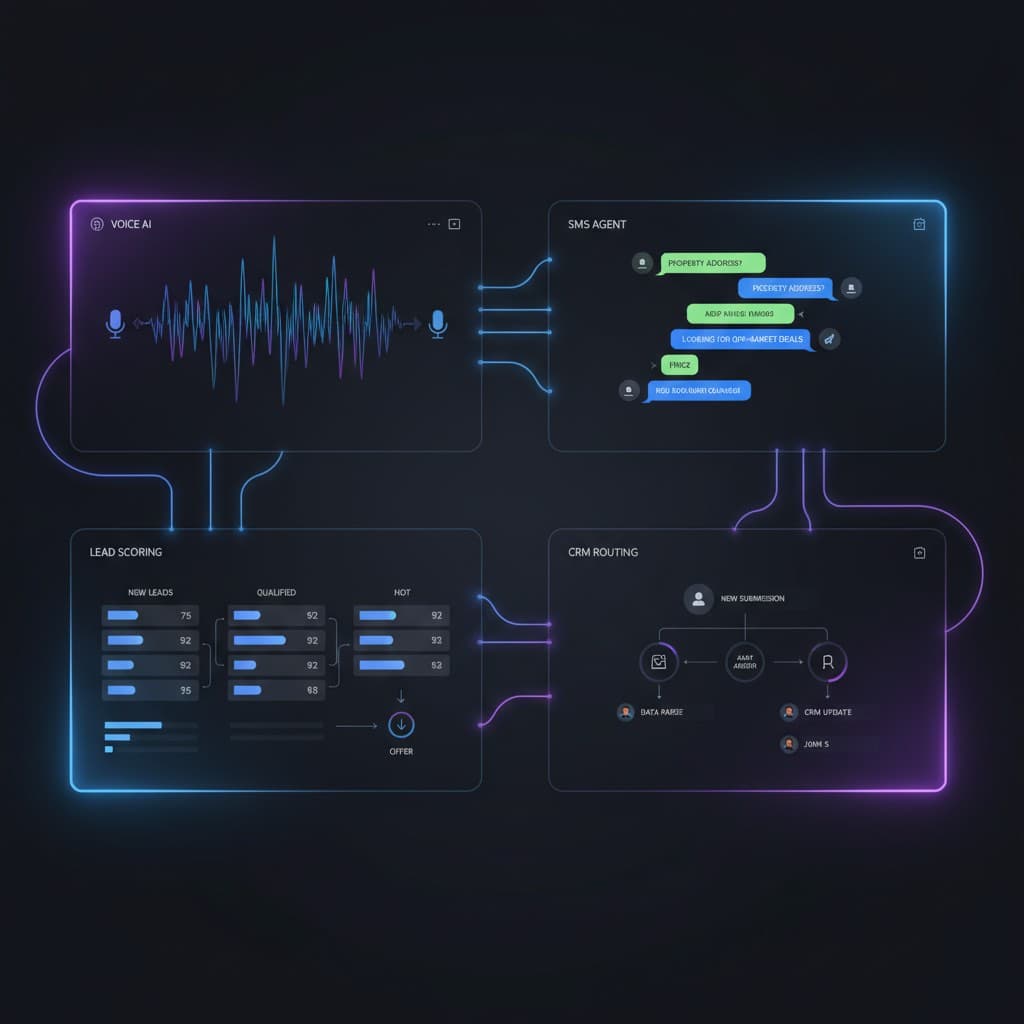
A multi agent system for real estate is the exact same org chart, except each role is an AI agent instead of a human. That is what makes the multi agent system framing so useful for investors - you already think in roles. The list-manager agent pulls and dedupes data. The cold-caller agent dials. The lead-qual agent triages. They each have one job. They pass the lead down the line. The handoffs are the most important part, just like they are for your human team.
This is why I am bullish on AI for real estate. The work was already chunked into discrete roles. We are just rebuilding those roles in software, one agent at a time. We go deeper on how that plays out specifically for wholesalers on our AI for wholesalers service page.
A Diagram of How the Multi Agent System Connects
Here is the simplest possible diagram of a wholesaling multi agent system. I am drawing it in markdown so you can see the data flow without needing a fancy chart.
[ Skip-traced list (PropStream) ]
              |
              v
   +----------------------+
   |  AGENT 1: Dialer     |     <-- VAPI voice agent makes calls
   |  (voice agent)       |         pulls phone numbers from CRM
   +----------------------+         logs disposition after each call
              |
   call outcome + transcript
              |
              v
   +----------------------+
   |  AGENT 2: Qualifier  |     <-- LLM agent reads transcript,
   |  (text agent)        |         scores motivation 1-10,
   +----------------------+         tags timeline & condition
              |
       qualified lead
              |
              v
   +----------------------+
   |  AGENT 3: SMS / Email|     <-- Drip nurture agent sends
   |  (nurture agent)     |         personalized follow-ups based
   +----------------------+         on what the seller actually said
              |
       hot lead detected
              |
              v
   +----------------------+
   |  AGENT 4: Router     |     <-- Updates REsimpli/Podio,
   |  (CRM agent)         |         books appointment, alerts you
   +----------------------+
              |
              v
       Your inbox / calendar
Every arrow in that diagram is a handoff. Every box is an agent. The little notes on the right are the agent's job description. That is ai agent orchestration in its simplest form: a clear pipeline with clean handoffs.
Three Worked Examples From Our Agency
Definitions and diagrams are fine, but they do not make the dollar value obvious. So here are three real systems we have deployed for clients in the last 12 months. Numbers are real, names are not.
Example 1: Outbound Wholesaler Multi Agent System (4 agents)
A wholesaler in Phoenix was paying $9,400 per month for a four-person Filipino VA dialing team. They wanted to keep the volume but cut the cost. We replaced the dialing team with a four-agent stack.
- Agent 1 (Voice): A VAPI assistant (ID
4c0a13d7-f723-4a6c-bcca-a26f7214da2d) that answers seller calls and works opted-in follow-up, asks the qualification questions, and detects motivation in the seller's voice - Agent 2 (Transcript Analyzer): A Claude agent that reads the call transcript right after the call ends, scores motivation, tags property condition, and extracts the seller's timeline
- Agent 3 (SMS Nurture): A second agent that sends a follow-up text within 90 seconds of the call ending, written specifically to reference what the seller said
- Agent 4 (Router): A small workflow agent that decides whether to push the lead to the acquisition manager's calendar (hot), the nurture sequence (medium), or the dead-lead archive (cold)
Result after 90 days: same call volume, $1,800/month total spend instead of $9,400, and a 14% higher contact-to-appointment rate because the SMS follow-up was instant and personalized. The wholesaler kept his one human acquisitions manager because closing the contract is still better with a person on the line. You can see how we build the voice piece specifically on our AI voice agent for real estate page.
Example 2: Inbound Lead Qualification Multi Agent System (3 agents)
A flipper in Tampa was getting 40-60 PPC leads a week through their Carrot site but losing most of them because the leads came in after hours. We built a three-agent inbound system.
- Agent 1 (Receptionist): A VAPI inbound agent that answers the call inside one ring, 24/7, and conducts a 90-second qualification conversation
- Agent 2 (Scoring): A scoring agent that reviews the call and the form submission together, gives the lead an A/B/C grade, and writes a one-paragraph summary
- Agent 3 (Dispatcher): A dispatcher agent that pages the on-call acquisitions person on Slack for A leads, books the seller directly on the calendar for B leads, and drops C leads into a 30-day nurture
The client went from 8% lead-to-appointment to 22% in the first six weeks. The agents do not close any deals themselves. They just make sure no good lead ever hits voicemail.
Example 3: Dispo-Side Multi Agent System (2 agents)
A wholesaler in Atlanta with a 4,000-name buyers list wanted to stop blasting every deal to every buyer. We deployed two agents on the dispo side.
- Agent 1 (Matcher): Reads the new deal, looks at each buyer's stated criteria (zip codes, ARV ranges, property type), and ranks the top 25 most-likely buyers
- Agent 2 (Outreach): Sends a personalized SMS to each of those 25, monitors replies, and books interested buyers directly onto the wholesaler's calendar
Dispo time on the average deal went from 11 days to 3 days. Buyer complaints about "spammy blast texts" dropped to zero, because nobody is getting deals that do not fit their box.
The Tools You Actually Use to Build a Multi Agent System
This is the section where most articles get drowned in jargon. I am going to keep it short and only list the tools we actually deploy.
CrewAI
CrewAI is the most "team metaphor" of the agent frameworks. You literally define agents by their role, their goal, and their backstory, then assign them to a "crew" that works together on a task. It is the easiest framework to explain to a non-technical operator because the abstractions match how you already think about your team.
We use CrewAI when the workflow is mostly sequential and the agents are doing research-heavy tasks (market analysis, comp pulling, due diligence summaries).
LangGraph
LangGraph is more flexible and more technical. Instead of a linear "crew," you describe the workflow as a graph: nodes (agents) connected by edges (decisions). It is the right tool when the flow has loops, branches, or conditional handoffs.
We use LangGraph for the routing logic in our inbound multi agent system deployments, because the agent that decides "page the human / book the calendar / nurture" needs to look at multiple inputs and choose a branch.
Claude Agents (and the Claude Agent SDK)
Claude agents, built on the Claude Agent SDK, are what we reach for when we want a single very smart agent with broad tool access - file system, web browsing, code execution. They are not always part of a multi-agent stack, but they are often the "manager" agent that coordinates the others, especially when the work involves writing code or interacting with messy CRM data.
We have written about how Claude fits next to other tools in our Make vs n8n vs Claude Code comparison.
VAPI for the Voice Layer
Almost every system we build has a voice agent at the front door or making outbound calls, and we use VAPI for that piece. The assistant powering our own widget is the same one we deploy for clients (ID 4c0a13d7-f723-4a6c-bcca-a26f7214da2d). VAPI handles the speech-to-text, the LLM brain, the text-to-speech, and the telephony - which would otherwise be four separate vendors to wire together.
n8n or Make as the Glue
Once the agents exist, something has to pass data between them, retry failed calls, log everything to your CRM, and handle the boring plumbing. That is what n8n and Make.com are for. We default to n8n self-hosted because the per-execution pricing kills you at any meaningful volume on the others.
MCP Servers for Tool Access
If you want your agents to actually do things in the real world, query your CRM, send a text, look up a property, they need tools. The modern standard for giving an agent tools is the Model Context Protocol. We wrote a full primer in our MCP servers guide if you want to go deeper.
Why a Multi Agent System Beats "One Big Agent" Every Time
I get this question on almost every discovery call: "Why not just have one really smart agent do everything?"
Three reasons, in order of importance.
1. Context windows are finite. Even with massive context windows, the more you cram into one prompt, the worse the agent performs. We have measured this. A single agent trying to do qualification + nurture + routing makes mistakes about 22% of the time on our internal evals. Three specialized agents doing the same job in sequence drop the error rate under 4%.
2. Debugging is impossible with one agent. When something goes wrong with a single mega-agent, you have no idea which part of its reasoning failed. With a multi agent system, the breakage is always in a specific handoff or a specific role, and you can fix that one agent without retraining the others.
3. Cost. A single agent doing every task uses the most expensive model on every step, because the hardest step requires that model. A multi-agent stack uses the cheap, fast model for simple steps (transcription, formatting) and saves the expensive model for the steps that need real reasoning (qualification scoring, routing decisions). On our deployments this typically cuts inference cost by 60-70%.
For more on how this scales into autonomous workflows, our guide to autonomous AI agents for business goes deeper on the architecture choices.
What a Multi Agent System Cannot Do (Yet)
I am going to be honest about the limits of a multi agent system, because if I oversell this you will hate me in six months.
A multi agent system is not magic. Specifically:
- They cannot do anything you have not described well. If your human team has never written down the qualification script, you cannot hand it to an agent and expect a result. Process design comes first.
- They cannot replace the closer on a $40K assignment fee. The acquisitions manager who walks the property and signs the contract is still a human. The agents get them in the right rooms.
- It cannot survive bad data. Garbage skip-traced numbers in, garbage outbound calls out. A multi agent system amplifies the quality of your data, in both directions.
- They cannot self-improve without supervision. You still need a human reviewing transcripts weekly to catch where the agents drift. We do this for every client we run a system for.
If you go in with realistic expectations, the ROI is enormous. If you expect Skynet, you will be disappointed.
How to Get Started Without Hiring an AI Agency
If you want to experiment yourself before paying anyone, here is the path I would take if I were starting from scratch this weekend.
- Pick one workflow. The inbound lead qualification one is the easiest because there is a clear trigger (form fill or phone call) and a clear success metric (booked appointment).
- Map the human version. Write down every step a human would take. This is your agent count and your handoff list.
- Build one agent first. Just the inbound voice receptionist. Get it answering calls reliably. Stop there for two weeks and gather data.
- Add the second agent. A scoring agent that reads the transcript and decides A/B/C. Wire its output into a Slack channel for now.
- Add the third agent. The dispatcher that actually books or routes. Now you have a real multi agent system in production, and the term "multi agent system" stops being abstract.
You can do all of this on a $200/month software budget if you are technical. You will burn 40-60 hours learning. That is the trade-off.
If you would rather skip that and have us build it for you, that is the AI agency work we do every day. Either path is fine. The important thing is to actually start.
The Real Takeaway on the Multi Agent System
A multi agent system is not new technology. It is a new way to organize existing technology, modeled on the way you have always organized humans. Each agent has one job. The agents pass work between each other. A simple set of rules decides who runs when. That is the entire idea.
For real estate investors specifically, the multi agent system approach maps almost one-to-one onto roles that already exist on your team. That is why this wave of AI is hitting our industry harder and faster than most others. The work was already broken into chunks. We are just rebuilding the chunks in software.
Start with one agent. Add a second. Add a third. In six months you will have a quietly humming agent team handling the work that used to require four humans, and you will wonder why you ever found the term "multi agent system" intimidating.
If you want to talk through which workflow to tackle first, book a call from the AI agency for real estate investors page. I do the discovery calls myself.
Founder & CEO, White Space Solutions
Jason builds AI automation systems for real estate investors and business owners. With experience spanning data analytics, direct mail automation, AI voice agents, and revenue intelligence, he helps companies replace manual workflows with intelligent systems that drive measurable results.
Related Articles
5 AI Agents Every Real Estate Investor Needs
The 5 AI agents for real estate investors that replace VAs: acquisitions, dispo, lead qual, follow-up, and ops. Roles, tooling, hand-offs, and real pricing.
Build Your AI Agent Team: Voice & SMS
Build an AI agent team for real estate: acquisitions, dispo, lead qual, follow-up, and ops roles with tooling, hand-off protocols, and real cost ranges.
AI Agency for Real Estate: Buyer's Guide
How to evaluate an AI agency for real estate investing: engagement models, pricing benchmarks, red flags, and the exact questions to ask before signing.
Run Your Wholesaling Business With 3 AI Agents
How to run a real estate wholesaling business with 3 AI agents - Acquisitions, Dispo, and Ops. Daily output, cost, and the scale path I use with clients.