Build Your AI Agent Team: Voice & SMS
Build an AI agent team for real estate: acquisitions, dispo, lead qual, follow-up, and ops roles with tooling, hand-off protocols, and real cost ranges.
The investors I work with all hit the same wall around deal #50: they can't hire fast enough to keep up with their own marketing. A virtual assistant takes two weeks to onboard, costs $1,200 a month, and quits after four. Meanwhile leads are stacking up in a Google Sheet titled "FOLLOW UP MAYBE."
The fix isn't another VA. It's an AI agent team - a group of specialized agents that each own one job, hand work to each other cleanly, and run 24/7 without sleep, sick days, or attitude.
I've spent the last 18 months building this exact stack for wholesalers and flippers doing 5 to 50 deals a year. This guide is the org chart I use, the tools per role, the hand-off protocol that keeps leads from falling through cracks, and real cost ranges so you can budget before you build.
Let's go ahead and jump into it.
What Is an AI Agent Team?
An AI agent team is a coordinated set of autonomous AI agents, each with a narrow specialty, that work together to run a business function end-to-end. Instead of one giant model trying to do everything, you have a phone agent that only handles inbound calls, a qualification agent that only scores leads, a follow-up agent that only writes SMS sequences, and so on.
The reason this works better than a single "do-it-all" assistant comes down to two things. First, narrow agents are easier to evaluate - when something breaks, you know exactly which agent failed and why. Second, narrow agents are cheaper to run because they use smaller context windows and shorter prompts.
If you want the broader theory behind why multi-agent systems beat monolithic ones, I wrote a deeper piece on autonomous AI agents that walks through the architecture patterns. For this guide, I'm focused on the practical question: what does an ai agent team for real estate actually look like when you build one?
Why Real Estate Investors Need a Multi-Agent Approach
Real estate is unusual because the buyer journey spans weeks or months, touches multiple channels, and has wildly different qualification criteria depending on the lead source. A motivated seller from a probate list needs a different conversation than a PPC lead from a "sell my house fast" ad.
A single AI assistant trying to handle all of that produces mediocre results across the board. A multi-agent real estate setup, where each agent is tuned for one role, produces specialist-grade output everywhere. That's the entire pitch.
The AI Agent Team Org Chart
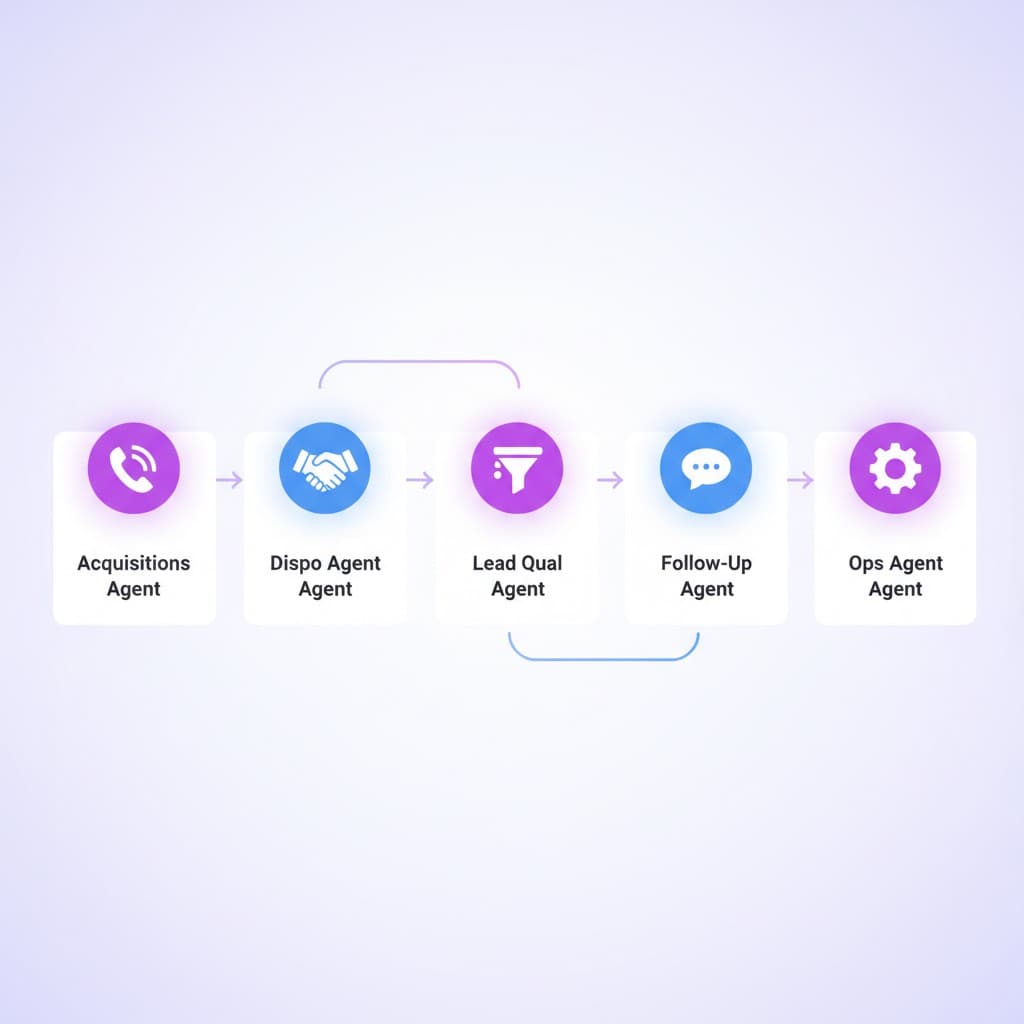
Here's the org chart I deploy for every investor client. Five roles, clear hand-offs, one shared data layer.
| Role | Primary Job | Channel | Hand-Off Trigger |
|---|---|---|---|
| Acquisitions Agent | Talk to inbound sellers, qualify motivation | Voice | "Hot" lead → Dispo Agent |
| Dispo Agent | Match contracts to buyer list, negotiate assignments | SMS + Email | Signed contract → Ops Agent |
| Lead Qual Agent | Score new leads, route to right channel | Background | Score ≥ 7 → Acquisitions Agent |
| Follow-Up Agent | Long-tail SMS/email nurturing | SMS + Email | Re-engagement → Lead Qual Agent |
| Ops Agent | Title coordination, doc generation, reporting | Email + Slack | Deal closed → CRM update |
Notice that no agent owns the deal end-to-end. Each one does its narrow job and passes the lead forward. This is the same way a 50-person real estate team works - and it's why this structure scales the same way without the headcount.
Why Five Agents and Not Three (or Ten)
I've tested team sizes from two to twelve. Three is too few, you end up with one agent doing both qualification and follow-up, which means the prompt gets bloated and accuracy drops. Ten is too many, you spend more time orchestrating than the agents save you.
Five is the sweet spot for a single-market wholesaler doing under 100 deals a year. If you're running multiple markets or adding rental acquisitions, you'd split the Acquisitions Agent into two and add a sixth (Buyer Agent for rentals). Otherwise, this is the right shape for an ai agent team in real estate.
Agent #1: The Acquisitions Agent (Voice)
The Acquisitions Agent is the loudest seat on the roster. It picks up the phone when a seller calls from your direct mail, PPC, or SEO, and runs a structured discovery script designed to qualify motivation in under four minutes.
Tooling
- Voice layer: VAPI (assistant ID
4c0a13d7-f723-4a6c-bcca-a26f7214da2dfor my production agent - copy the pattern, not the ID) - LLM: GPT-4o or Claude Sonnet 4.5 for the reasoning
- Telephony: Twilio number with call recording
- CRM write: Webhook into REsimpli or Podio
What It Does
- Answers in under two rings
- Greets the seller, captures property address, and verifies ownership
- Asks the motivation questions (timeline, condition, asking price, mortgage balance)
- Scores the lead on a 1 to 10 motivation scale
- Books a follow-up appointment or hands the call to a live human if the lead is hot
If you want the full build, my AI voice agent for real estate page covers the production setup. The shorter version: build it in VAPI, give it a tight system prompt, and run weekly eval suites against recorded calls to catch regressions.
Cost
- VAPI usage: ~$0.08 to 0.15 per minute of conversation
- LLM tokens (included in VAPI bundle): ~$0.02 to 0.05 per call
- Twilio inbound: ~$0.015/min
- Total per call: $0.40 to $1.20 for a typical 4-minute qualification call
- Monthly at 500 calls: roughly $200 to $600 (TODO: validate against your actual call volume)
Agent #2: The Dispo Agent (SMS + Email)
Once the Acquisitions Agent gets a property under contract, the Dispo Agent takes over. Its job is to find a cash buyer fast, usually within 72 hours, by matching the property against your buyer list and blasting the right subset.
Tooling
- SMS: Twilio or SimpleTexting for the bulk send
- LLM: Claude Sonnet 4.5 for buyer-list segmentation and message writing
- Data: Your existing buyer list in Airtable or a Postgres table
- Orchestrator: n8n or Make for the workflow glue
What It Does
- Segments your buyer list by zip code, property type, and price range
- Writes a property-specific SMS pitch (not the generic "deal alert" blast everyone ignores)
- Sends in batches of 25 to 50 to stay under carrier spam thresholds
- Tracks replies, scores buyer intent, and books showings on your calendar
- Hands the signed assignment contract to the Ops Agent
This is the agent that makes the whole stack feel magical. The first time you see a property go from contracted to assigned in 18 hours without anyone touching a phone, you understand why this approach beats hiring a dispo coordinator.
Cost
- SMS: ~$0.0079 per segment (Twilio US)
- LLM tokens: ~$0.30 to 0.80 per property pitch generation
- Monthly at 8 properties dispo'd: roughly $80 to $200 (TODO: depends on buyer list size)
Agent #3: The Lead Qual Agent (Background)
The Lead Qual Agent never talks to a human. It sits in the background and scores every new lead that hits your funnel, from PPC, Facebook ads, cold callers, SEO forms, direct mail responses, and routes them to the right next-step channel.
Tooling
- LLM: Claude Haiku or GPT-4o-mini (cheap, fast, perfect for scoring)
- Enrichment: PropStream or PropertyRadar API for property data lookups
- Orchestrator: n8n workflow triggered by webhook from each lead source
- Output: Score 1 to 10 + routing decision written back to CRM
What It Does
- Pulls property data (ARV, equity, lien status) from your data provider
- Reads any free-text the seller submitted
- Cross-references against your "do not contact" list
- Outputs a structured JSON:
{score: 8, route: "acquisitions_voice", reason: "high equity + probate"} - Triggers the right next agent automatically
A good Lead Qual Agent eliminates the "which lead do I call first?" problem that kills most solo investors. Your morning queue shows up pre-sorted by likelihood to close.
Cost
- LLM: ~$0.001 to 0.005 per lead scored (these are tiny calls)
- Data enrichment: ~$0.10 to 0.25 per property lookup
- Monthly at 1,000 leads: roughly $100 to $250
Agent #4: The Follow-Up Agent (SMS + Email)
Most leads aren't ready in week one. The Follow-Up Agent owns the long tail - the leads that said "call me back in three months," the ones that went silent, the ones that need a 17-touch sequence before they sign.
Tooling
- SMS/Email: Customer.io or REsimpli for the cadence engine
- LLM: Claude Sonnet 4.5 for personalized message generation
- Memory: Postgres table tracking every touch + response
- Orchestrator: Scheduled n8n workflow running every 4 hours
What It Does
- Pulls leads due for follow-up based on the cadence rules
- Reads the conversation history (this is the critical part - generic follow-ups don't convert)
- Writes a context-aware SMS or email that references the last conversation
- Sends, logs, and updates the next-touch date
- Hands re-engaged leads back to the Lead Qual Agent for re-scoring
If you're already running an AI voice agent on inbound, the Follow-Up Agent is what keeps those leads warm between touches. Together they form the spine of a multi-agent real estate stack.
Cost
- SMS: ~$0.0079 per segment
- Email: included in Customer.io plan (~$100 to 300/mo)
- LLM: ~$0.10 to 0.30 per personalized message
- Monthly at 2,500 follow-ups: roughly $200 to $500
Agent #5: The Ops Agent (Email + Slack)
The Ops Agent handles everything after a contract is signed. It coordinates title, generates docs, sends status updates to your Slack, and writes weekly reports. It's the least sexy agent on the team - and the one that saves the most hours.
Tooling
- LLM: Claude Sonnet 4.5
- MCP servers: Custom MCP for title company, DocuSign, and your CRM (see my MCP servers guide for the build pattern)
- Channels: Gmail API + Slack API
- Trigger: Webhook from CRM when stage changes to "Contracted"
What It Does
- Drafts the title company intro email with all property details
- Generates the assignment contract from a template
- Posts a daily "deals in motion" summary to your Slack
- Sends weekly KPI reports to your inbox
- Flags deals that are stuck (no movement in 5+ days)
Cost
- LLM: ~$2 to 8 per deal end-to-end
- MCP infrastructure: $20 to 50/mo for hosting
- Monthly at 8 deals: roughly $40 to $120
The Hand-Off Protocol
The hardest part of building an ai agent team isn't the agents - it's the hand-offs. Here's the protocol I use to keep leads from getting dropped between agents.
Rule 1: Every Hand-Off Writes to a Shared State
No agent owns its own database. All five agents read from and write to the same lead record in your CRM. When the Acquisitions Agent finishes a call, it doesn't "send" the lead to the Dispo Agent - it updates the lead's stage field to contracted and lets the Dispo Agent's trigger fire on the change.
This sounds obvious but it's where most teams get it wrong. They build agents that pass messages directly to each other, then spend weeks debugging why leads vanish. Shared state, event-driven triggers. Always.
Rule 2: Every Hand-Off Has a Confidence Score
When the Lead Qual Agent routes a lead to Acquisitions, it doesn't just say "call this person." It writes a confidence score and a reason. If the score is below 6, the lead routes to Follow-Up instead. If the score is between 6 to 8, it routes to a human review queue. Only 9 to 10 scores auto-route to the Acquisitions Agent.
This three-tier routing is what separates a production ai team from a demo. You will get bad scores. Build for it.
Rule 3: Every Hand-Off Logs to an Audit Trail
Every agent writes a single line to an agent_events table every time it acts: which agent, which lead, what it decided, what tokens it used, what tools it called. When something goes wrong, you can replay the entire decision chain in 30 seconds instead of digging through five different log files.
Cost: What an AI Agent Team Actually Runs
Here's a realistic monthly budget for a wholesaler doing 5 to 10 deals/month with 1,000 new leads.
| Line Item | Low End | High End |
|---|---|---|
| Acquisitions Agent (VAPI + telephony) | $200 | $600 |
| Dispo Agent (SMS + LLM) | $80 | $200 |
| Lead Qual Agent (LLM + enrichment) | $100 | $250 |
| Follow-Up Agent (SMS + email + LLM) | $200 | $500 |
| Ops Agent (LLM + MCP hosting) | $40 | $120 |
| Orchestration (n8n self-hosted VPS) | $15 | $40 |
| CRM (REsimpli or similar) | $99 | $299 |
| Total | ~$734 | ~$2,009 |
For context: one full-time virtual assistant runs $1,200 to $1,800/mo and handles maybe 200 leads/week. This stack handles 4 to 5x that volume at comparable cost - and it doesn't quit (TODO: validate exact volume against your stack).
How to Build an AI Team (Without Burning 6 Months)
I get this question every week: "Should I build it myself or hire someone?" Honest answer: it depends on whether you've shipped production AI before.
If you have, the build order I recommend is:
- Lead Qual Agent first. It's the cheapest to build, the easiest to evaluate, and it makes every other agent better by sending it cleaner leads.
- Acquisitions Agent second. Voice is the highest-leverage channel for real estate. Get this right before adding anything else.
- Follow-Up Agent third. Most of your revenue lives in week 4 to 12 of the lead lifecycle. Don't leave it on the table.
- Dispo Agent fourth. Only build this after you have consistent contract flow.
- Ops Agent last. This one saves time, not money. It's a quality-of-life upgrade.
If you haven't built production AI before, build the first two yourself (you'll learn the eval discipline you need) and bring in help for #3 to #5. Or if you'd rather skip the learning curve entirely, my team at White Space's AI agency for real estate builds the whole stack - that's literally what we do.
For wholesalers specifically, my AI for wholesalers playbook covers the wholesale-specific tweaks (probate logic, assignment contract automation, double-close handling) that don't apply to flippers or buy-and-hold investors.
Common Mistakes When You Build an AI Team
Three failure patterns I see constantly:
1. Building all five agents at once. You'll have five mediocre agents instead of one great one. Build sequentially, ship each one to production, and tune for two weeks before starting the next.
2. Skipping evals. If you can't run a regression test that proves your Acquisitions Agent still books appointments after a prompt change, you don't have a production agent - you have a science project. Build evals from day one.
3. Letting agents talk to each other directly. I covered this in the hand-off protocol but it bears repeating. Shared state. Event triggers. Never direct agent-to-agent messaging.
The Bottom Line
An ai agent team isn't a single product you buy - it's an architecture you assemble. Five specialized agents, clean hand-offs through shared state, evals on every agent, and a realistic monthly budget under $2K for most single-market wholesalers.
If you want help designing your specific stack, which agents to build first, which tools fit your existing CRM, what the realistic timeline looks like, book a call with my team. We'll map your current workflow, identify the highest-leverage agent to build first, and give you a build sequence that doesn't waste six months.
Build smart. Ship narrow agents. Let the team scale itself.
Founder & CEO, White Space Solutions
Jason builds AI automation systems for real estate investors and business owners. With experience spanning data analytics, direct mail automation, AI voice agents, and revenue intelligence, he helps companies replace manual workflows with intelligent systems that drive measurable results.
Related Articles
5 AI Agents Every Real Estate Investor Needs
The 5 AI agents for real estate investors that replace VAs: acquisitions, dispo, lead qual, follow-up, and ops. Roles, tooling, hand-offs, and real pricing.
Multi Agent Systems for Investors
A non-technical guide to multi agent systems for real estate investors. See how AI agents work together to run cold calling, lead qualification, and dispo.
AI Agency for Real Estate: Buyer's Guide
How to evaluate an AI agency for real estate investing: engagement models, pricing benchmarks, red flags, and the exact questions to ask before signing.
Run Your Wholesaling Business With 3 AI Agents
How to run a real estate wholesaling business with 3 AI agents - Acquisitions, Dispo, and Ops. Daily output, cost, and the scale path I use with clients.