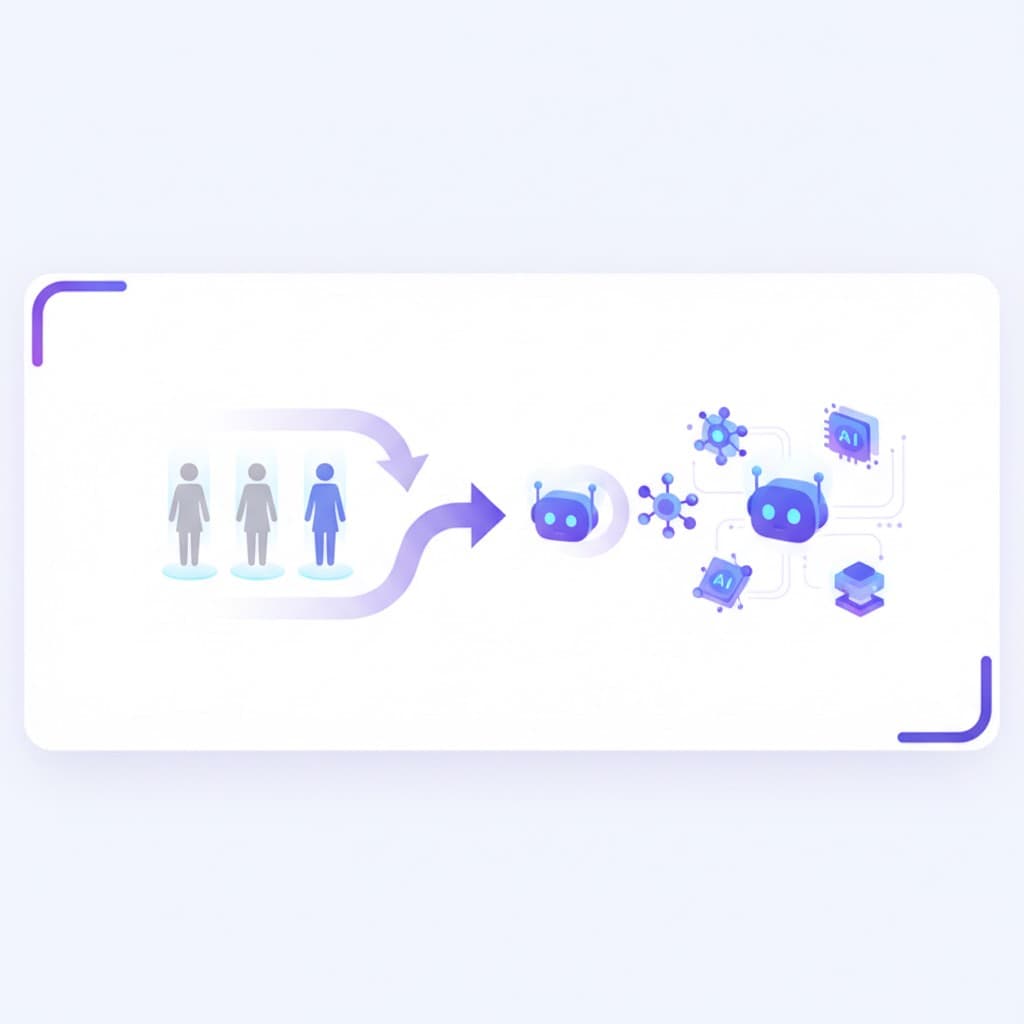
AI Workforce: From VA Team to Agent Team
How I replaced a 6-person VA team with an AI workforce over 12 months: role mapping, change management, the cost curve, and the migration playbook.
Twelve months ago, I had zero AI workforce, just six virtual assistants costing roughly $14,000 a month to run acquisitions support, lead qualification, dispo follow-up, transaction coordination, bookkeeping, and CRM hygiene for a real estate operation. Today, I'm running the same volume, actually about 28% more deal flow - with two humans and an AI workforce that never sleeps, never asks for time off, and never misses a follow-up at 11:47 PM on a Saturday.
This isn't a "fire your team and replace them with bots" article. The two humans I kept are the most important hires I've ever made. But the supporting cast, the repetitive, rules-based, "do this 400 times a week" work, is now handled by an AI workforce that I've built and rebuilt over the last year. If you're a real estate investor wondering how to build an AI workforce without breaking your operation, this guide is the playbook.
If you're a real estate investor staring at a payroll spreadsheet wondering whether you can pull this off, this is the migration playbook I wish someone had handed me in month one.
Let's go ahead and jump into it.
What Is an AI Workforce?
An AI workforce is a coordinated set of AI agents, voice agents, SMS agents, email agents, data agents, and workflow agents, that perform the operational work historically assigned to human employees or virtual assistants. Unlike a single chatbot or one-off automation, an AI workforce is structured like an org chart: each agent has a defined role, a defined toolset, and a defined hand-off protocol to other agents (or to a human).
An AI workforce for real estate operations typically covers four functional zones:
- Top-of-funnel: lead capture, enrichment, qualification, appointment setting
- Acquisitions: seller outreach, follow-up sequences, offer prep
- Disposition: buyer matching, blast notifications, contract routing
- Operations: transaction coordination, bookkeeping reconciliation, reporting
When people ask me what we build at White Space, the AI agency for real estate investors is the shortest answer. We build AI workforces. That's the product.
AI Workforce vs Automation vs AI Assistant
These terms get muddled in marketing copy, so let me clear them up.
| Concept | What It Does | Example |
|---|---|---|
| Automation | Executes a fixed rule when triggered | Zapier sends new Podio leads to Slack |
| AI Assistant | Answers questions or completes single tasks on demand | ChatGPT drafts a follow-up email when you ask |
| AI Agent | Pursues a goal, makes decisions, uses tools autonomously | Voice agent qualifies a seller lead end-to-end |
| AI Workforce | Multiple agents coordinating across a business function | Acquisitions agent hands a hot lead to a dispo agent who hands the contract to an ops agent |
The leap from "I have an AI assistant" to "I have an AI workforce" is the leap from saving 30 minutes a day to running an entire department without a department. If you want a deeper foundation on how autonomous agents actually work, I wrote a full primer here: Autonomous AI Agents: A Business Guide.
Why Real Estate Investors Are Building an AI Workforce Faster Than Other Industries
Real estate investing is unusually well-suited to an AI workforce for three reasons. An AI team for real estate also tends to outperform generic AI assistants because the workflows are narrow and repeatable.
1. The work is structured and repetitive. Seller calls follow predictable scripts. Lead qualification uses the same 8 to 12 criteria every time. Dispo blasts go to the same buyer list with the same property fields. AI agents thrive on structured, repeatable work.
2. Speed-to-lead is everything. A motivated seller calling at 9 PM doesn't want to hear back Tuesday morning. Studies from the Lead Response Management group have shown lead conversion drops by an order of magnitude when response time stretches from 5 minutes to 30. AI agents respond in seconds, 24/7.
3. Margins reward operational leverage. A wholesale assignment fee or fix-and-flip spread looks the same whether you spent $14,000 on payroll or $2,400 on agents to source it. The savings flow straight to the bottom line.
The 12-Month AI Workforce Migration: My Actual Timeline
Here's how to build an AI workforce in the real world, the migration narrative, not a theoretical roadmap, the actual sequence I ran. Your timeline will vary based on call volume, tech comfort, and how much you're willing to break things in production.
Months 1 to 2: Audit and Stabilize
Before I built a single agent, I sat down with every VA on the team and documented exactly what they did, how long it took, and where the work came from. I used a simple spreadsheet: role, task, frequency, time per task, system used, hand-off point.
The result was eye-opening. Of roughly 240 hours of VA work per week, about 168 hours (70%) were "rules-based pattern matching" - exactly the kind of work an AI agent can do better. The remaining 30% was judgment, relationship, and exception handling.
Action items in this phase:
- Document every recurring task across the team
- Tag each task as "rules-based," "judgment," or "relationship"
- Identify the 3 highest-volume rules-based tasks (these are migration #1)
- Don't touch payroll yet - you'll need the team to help you build
Months 3 to 4: Deploy the First Voice Agent
The single highest-leverage move was replacing inbound and outbound qualification calls with a voice agent. I deployed a VAPI-based agent (assistant ID 4c0a13d7-f723-4a6c-bcca-a26f7214da2d runs our current production stack) that handles initial seller qualification, captures the property details, scores motivation, and books a callback if the lead is hot.
If you want the full deep-dive on this specific build, I broke it down here: AI Voice Agent for Real Estate.
The first agent took about six weeks from kickoff to "good enough to take real calls." The first two weeks of live calls were a disaster - the agent over-promised, mishandled spousal disputes, and once told a seller we'd "send a check this afternoon" (we don't do that). Every failure became a prompt update or a guardrail.
By end of month 4, the voice agent was handling about 60% of inbound qualification autonomously, with the remaining 40% routed to a human VA for nuanced situations.
Months 5 to 6: Add the AI Cold Caller and SMS Agent
With inbound stabilized, I built follow-up. An AI voice agent working the leads who had already raised a hand, paired with an SMS follow-up agent for the 70%+ of contacts who didn't pick up.
This is where the "workforce" concept clicked for me. The voice agent and SMS agent had to share state - if the SMS agent already got a "not interested" reply, the voice agent shouldn't call back next week. We built a shared lead-state object in the CRM (we use REsimpli) that every agent reads and writes to.
This is also when I let two VAs go. Both got 60-day severance and glowing references. Two of the other four moved into "AI supervisor" roles, which I'll explain below.
Months 7 to 8: Disposition and Buyer Matching Agent
Dispo was the easiest migration because it's the most structured task in the business. Property comes under contract → match to buyer list by criteria → send personalized blast → handle replies → route the live ones to a human closer.
This agent ships at AI for wholesalers if you want the full architecture.
Months 9 to 10: Operations and Transaction Coordination
This was the hardest phase. Transaction coordination involves dozens of stakeholders, title companies, lenders, inspectors, buyers, sellers, agents, each with their own systems, communication preferences, and timelines.
I'd be lying if I said this is fully automated. It's not. What we built is an agent that maintains a checklist per deal, sends reminder emails when items are overdue, drafts status updates to all parties, and escalates exceptions to a human. The human still owns the relationship. The agent owns the paperwork.
Months 11 to 12: Reporting, Bookkeeping, and Optimization
The final agents handled the back-office layer - reconciling Mercury transactions to deal records, generating weekly P&L snapshots, flagging unusual activity, and producing the KPI dashboard I look at every Monday morning.
By month 12, the team was two humans (acquisitions lead + ops manager) plus the AI workforce. Treating AI employees in real estate as actual teammates, with onboarding, supervision, and performance reviews, is what separates a real AI workforce from a pile of disconnected scripts.
Role Mapping: From VA Org Chart to AI Agent Org Chart
This is the single most useful artifact from the migration - the side-by-side role map. Here's a simplified version of what we ran:
| Original VA Role | Hours/Week | AI Agent Replacement | Human Role Retained |
|---|---|---|---|
| Inbound Lead Qualifier | 30 | Voice qualification agent | Escalation handler (5 hrs) |
| Outbound Cold Caller | 40 | AI cold caller + SMS agent | Hot-lead closer (8 hrs) |
| Dispo Coordinator | 35 | Buyer-match + blast agent | Contract negotiator (10 hrs) |
| Transaction Coordinator | 40 | TC checklist + reminder agent | Relationship owner (15 hrs) |
| Bookkeeping Assistant | 25 | Reconciliation agent | CFO review (3 hrs) |
| CRM Hygiene VA | 20 | Data enrichment agent | None - fully automated |
| Marketing Ops VA | 25 | Multi-channel sequence agent | Creative direction (5 hrs) |
| Total | 215 | 7 agents | 46 human hours |
Two important things to notice. First, the human work didn't go to zero - it went from 215 hours/week of VA time to about 46 hours/week split across two senior team members. Second, the work the humans do now is significantly more valuable per hour: closing, negotiating, managing relationships, making judgment calls.
Change Management: The Part Nobody Talks About
I think the technical side of standing up an AI workforce is genuinely the easier half. The harder half is change management - both for your existing team and for yourself.
For the team: I told everyone what we were doing in month two. Full transparency: "We are going to migrate to an AI-first operation over the next 12 months. Some roles will go away. Some will evolve. Here's the timeline. Here's who we're keeping in what capacity. Here's the severance for anyone we let go." Two VAs chose to leave on their own timeline once they heard the plan. The rest stayed and helped build the agents that eventually replaced parts of their own jobs. I paid migration bonuses to the ones who helped build their replacements.
For yourself: You will trust the agents too much in month four and too little in month eight. You will catch the agent making a stupid mistake at 2 AM and want to rip the whole thing out. You will ship a prompt change on a Friday afternoon and realize Saturday morning that you broke the appointment-setting flow for 30 leads. This is normal. Build a "human-in-the-loop" review queue for every agent for the first 90 days, and don't remove it until you have 30 consecutive days of clean output.
For your operating partners (lenders, title, JV partners): Tell them. Don't surprise them with a voice agent calling about wire instructions. Most will be curious and impressed. A few will push back. Let the pushback inform which interactions stay human-led.
The Cost Curve: What This Actually Costs
This is the question I get asked most, so let me give you actual ranges. Your numbers will differ based on call volume, lead count, and which platforms you use, but this is the shape of the curve I've seen across our client base.
| Month | Approx Monthly Cost | What's Included |
|---|---|---|
| Month 0 (baseline VA team) | $12,000 to $18,000 | 5 to 7 VAs + management overhead |
| Months 1 to 2 (audit) | Same as baseline | No infra changes yet |
| Months 3 to 4 (first voice agent) | $13,000 to $19,000 | Baseline + ~$1,200/mo for VAPI + LLM tokens |
| Months 5 to 6 (cold caller + SMS) | $11,000 to $15,000 | Reduced VA count + ~$2,500 to $3,500/mo agent infra |
| Months 7 to 8 (dispo agent) | $8,000 to $11,000 | Further VA reduction + ~$3,000 to $4,000/mo infra |
| Months 9 to 10 (TC + ops agents) | $5,000 to $7,500 | 2 humans + ~$3,500 to $5,000/mo agent infra |
| Month 12 (steady state) | $4,800 to $6,500 | 2 humans + ~$2,500 to $3,500/mo agent infra (after optimization) |
A few notes on these ranges:
- The agent infra cost spikes in months 7 to 10 because you're running redundant systems (humans + agents) for safety
- After month 10 the cost actually drops as you decommission tools the VAs were using (Calltools, multiple SMS platforms, etc.)
- {/* TODO: confirm exact post-migration infra cost - last audit showed ~$3,100/mo across VAPI, OpenAI, Twilio, and orchestration; will vary by call volume */}
- Steady-state savings vs baseline: roughly 55 to 70% reduction in monthly operating cost while handling 25 to 30% more volume
The Three Mistakes I Made (So You Don't Have To)
1. I tried to build the most complex agent first. Don't. Start with the highest-volume, lowest-risk task. For most investors that's inbound lead qualification or dispo blast personalization. Save transaction coordination for month 8.
2. I underinvested in observability. For the first three months I didn't have proper logging on agent decisions. When something went wrong, I had no way to debug. Now every agent writes a structured log of every decision to a queryable store. If you build nothing else, build observability first.
3. I waited too long to tell the team. I should have been transparent in month one, not month two. The VAs figured out what was happening anyway, they're not stupid, and the four weeks of uncertainty hurt morale more than the eventual conversation did.
Should You Build or Buy Your AI Workforce?
The build-vs-buy decision for an AI workforce comes down to time and risk tolerance.
If you're a developer with time on your hands, building from scratch using VAPI + n8n + a CRM API is absolutely viable. Expect 4 to 6 months of nights and weekends and a steep learning curve on prompt engineering, agent orchestration, and failure recovery.
If you're a real estate investor who'd rather close deals than learn LangChain, buying a managed AI workforce makes more sense. A pre-built AI workforce gives you most of the cost savings without the months of trial and error. This is exactly what we do at White Space, AI agency for real estate investors, and we've now run this migration playbook for dozens of operations across wholesaling, fix-and-flip, rental portfolios, and creative finance.
What "Done" Looks Like
A year into the migration, here's what a typical week looks like for me:
- I review agent decision logs for 20 minutes on Monday morning
- I approve any agent prompt changes proposed by my ops manager
- I look at the KPI dashboard the reporting agent generates
- I spend the rest of the week on deal sourcing, partner conversations, and capital relationships
The work I used to do, managing a VA team, chasing tasks, refereeing hand-offs, fixing CRM data, is gone. Not because I gave it to someone cheaper. Because I gave it to a system that runs itself.
That's the actual promise of an AI workforce. Not "AI does everything." Not "fire your team." The promise is that the operational center of your business runs on its own, and you get to spend your time on the work that only you can do.
If that sounds like something you want for your operation, let's talk. I'll walk you through the migration, share the role-mapping template, and give you an honest read on whether you should build it yourself or have us build it for you.
The next 12 months are going to reshape real estate investing operations the same way the previous 12 reshaped ours. The question is whether you'll be running an AI workforce by this time next year - or still managing the VA spreadsheet while your competitors operate on an AI workforce that doesn't sleep.
Founder & CEO, White Space Solutions
Jason builds AI automation systems for real estate investors and business owners. With experience spanning data analytics, direct mail automation, AI voice agents, and revenue intelligence, he helps companies replace manual workflows with intelligent systems that drive measurable results.
Related Articles
VA to AI Migration: 12-Month Guide
A month-by-month VA to AI migration playbook for real estate investors. Cost curves, change management, and lessons from rebuilding our team from scratch.
AI vs Virtual Assistant: 2026 Comparison
AI vs virtual assistant real estate breakdown. Real costs, quality scorecard, when each wins, and the hybrid model that beats both for serious investors.
Your AI Back Office for Real Estate
Build an AI-powered real estate back office that automates transactions, comms, and reporting. Tool list, ROI calculator, and workflow diagrams inside.
Real Estate Operating System (2026)
The complete real estate operating system for 2026 investors: REsimpli, PropStream, Customer.io, VAPI, and n8n - with integration map, costs, and setup.