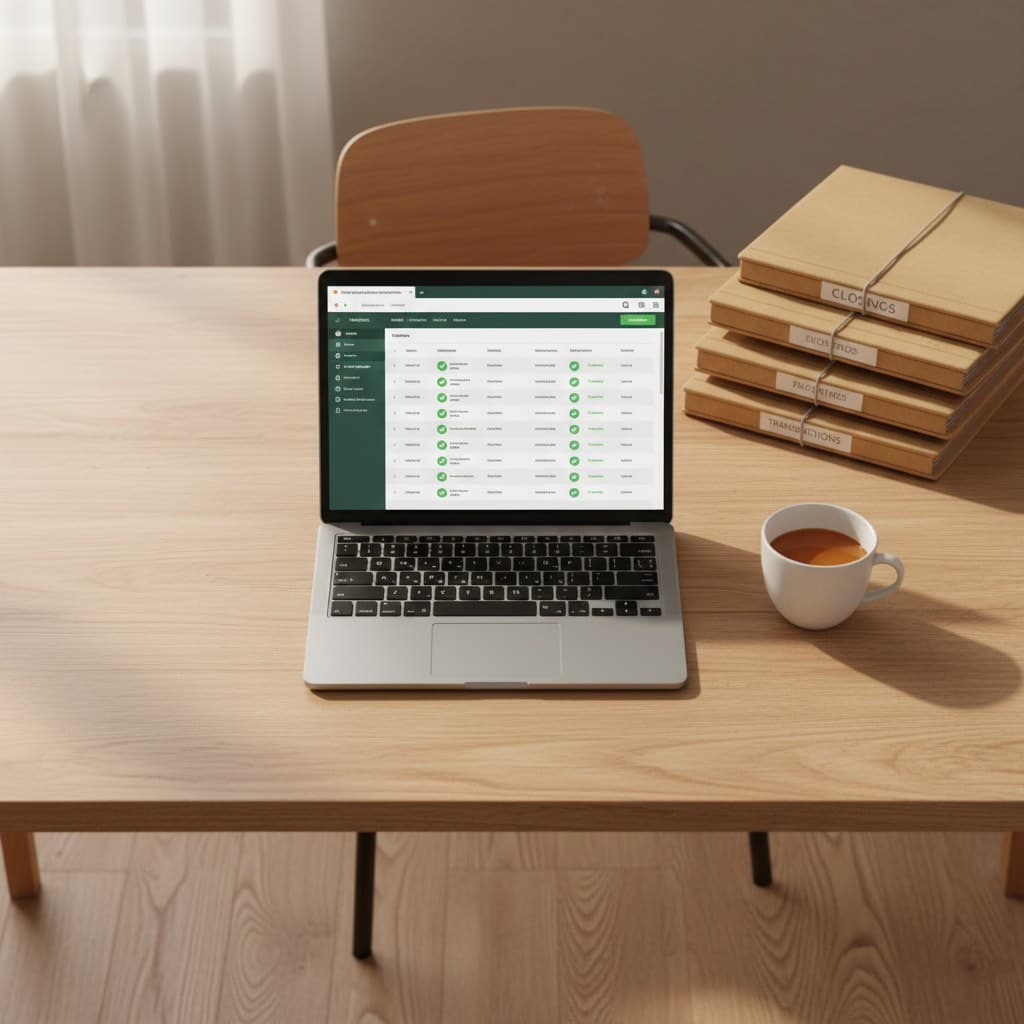
Your AI Back Office for Real Estate
Build an AI-powered real estate back office that automates transactions, comms, and reporting. Tool list, ROI calculator, and workflow diagrams inside.
Every real estate investor I've worked with hits the same wall around deal 30 of the year. The deals are flowing, the marketing is humping, and then the back office grinds the whole operation to a halt. Title chases, earnest-money receipts, contractor invoices, weekly KPI reports for the partners, transaction-coordinator handoffs - it all eats your week before you've made a single outbound call.
A modern real estate back office shouldn't be a person hunched over a Podio dashboard at 9 p.m. on a Sunday. In 2026, it's an AI-powered layer that handles transactions, communications, and reporting automatically, with a human reviewing exceptions instead of pushing paper. That's exactly what we build for our clients, and this guide walks through how to assemble one yourself.
Let's get into it.
What Is a Real Estate Back Office (And Why Yours Is Broken)
Your real estate back office is everything that happens after the lead converts: contract execution, transaction coordination, document collection, vendor management, accounting, and partner reporting. It's the unglamorous infrastructure that determines whether you close 50 deals a year or 200.
Most investor back offices are broken for the same three reasons:
- They're built on humans copy-pasting between tools - REsimpli to DocuSign to QuickBooks to Google Sheets, manually, every single transaction.
- The reporting layer is an afterthought - partners ask "how much did we make last month?" and someone burns half a day in a spreadsheet.
- Comms fall through the cracks - title companies, buyers, sellers, contractors all expect updates, and nobody owns the follow-up.
An AI-powered real estate back office replaces the copy-paste layer with agents that read documents, write updates, sync systems, and surface only the decisions a human actually needs to make. Done right, this kind of real estate operations automation can give a 4-person team the output of a 10-person team without adding headcount.
For our full implementation approach, see our AI agency for real estate services page.
The 4 Pillars of a Real Estate Back Office
Think of your real estate back office as four stacked layers. Each one is a candidate for AI back office automation and real estate admin automation.
┌─────────────────────────────────────────────────┐
│  PILLAR 4: REPORTING & DECISIONS                │
│  Weekly P&L, KPI digests, exception alerts      │
├─────────────────────────────────────────────────┤
│  PILLAR 3: COMMUNICATIONS                       │
│  Title, buyers, sellers, contractors, partners  │
├─────────────────────────────────────────────────┤
│  PILLAR 2: TRANSACTION COORDINATION             │
│  Contracts, docs, deadlines, EM, closings       │
├─────────────────────────────────────────────────┤
│  PILLAR 1: DATA & SYSTEMS OF RECORD             │
│  CRM, accounting, storage, e-sign, calendar     │
└─────────────────────────────────────────────────┘
Pillar 1 is your foundation - without clean data flowing into a single source of truth, the AI layers on top will hallucinate or duplicate work. Pillars 2 to 4 are where back office automation pays for itself.
Pillar 1: The Real Estate Back Office Data Layer
Before you automate anything in your real estate back office, pick one CRM and make it the source of truth. We see investors running REsimpli, Podio, Salesforce, or HubSpot. The platform matters less than the discipline of putting everything there.
Recommended stack:
| Layer | Tool | Why |
|---|---|---|
| CRM | REsimpli or Pipedrive | Deal pipeline + contact log |
| Accounting | QuickBooks Online | Bank feeds + 1099s |
| E-sign | DocuSign or PandaDoc | Contracts, addendums |
| Storage | Google Drive or Dropbox | Transaction folders |
| Calendar | Google Workspace | Closings, inspections |
| Automation glue | n8n or Make | Move data between all the above |
Once these are connected, you have a real estate back office that an AI agent can actually operate on. Without this clean foundation, no amount of real estate back office automation will stick. If you're using Airtable as a lightweight CRM or ops hub, our Airtable automation guide walks through the integration patterns we use most.
Pillar 2: Real Estate Back Office Transaction Coordination
This is where real estate back office automation delivers the most obvious wins. A typical wholesale or flip transaction has 30 to 50 micro-tasks between contract and close. Most of them are predictable.
Workflow Diagram: AI Transaction Coordinator
[Contract Signed in DocuSign]
            ↓
[Webhook → n8n]
            ↓
┌────────────────────────────────────┐
│ AI Agent reads contract PDF        │
│  • Extracts addresses, dates, $    │
│  • Identifies title company        │
│  • Flags non-standard clauses      │
└────────────────────────────────────┘
            ↓
[Create deal in CRM + transaction folder in Drive]
            ↓
[Generate closing checklist + calendar deadlines]
            ↓
[Email title company w/ EM wire request]
            ↓
[Slack the team: "New contract - review in 24h"]
The AI doesn't replace the transaction coordinator - it does the data-entry portion of the role so your human TC can focus on judgment calls (title issues, seller wobble, financing fall-through).
What to automate first:
- Contract intake - parse signed PDF, populate CRM fields, create folder structure.
- Deadline tracking - auto-generate calendar events for EM deadline, inspection period, financing contingency, closing date.
- Document collection - chase missing items (seller's disclosure, payoff letters, HOA estoppel) via templated emails.
- Closing prep - 7 days before closing, AI assembles a closing packet and pings the team if anything is missing.
In our deployments, this single workflow saves the average TC role 12 to 18 hours per week. (TODO: validate against latest internal time-tracking - currently based on Q1 2026 audit across 3 clients.)
Pillar 3: Automating Communications
Real estate is a communications business. Title companies want updates. Buyers want to know if their deal is still alive. Sellers spiral if you go quiet. Contractors ghost if you don't follow up. A real estate back office that handles comms well is a real estate back office that closes more deals - and comms is where most real estate admin automation projects find their second-biggest win.
The AI Comms Stack
| Channel | AI Tool | Use Case |
|---|---|---|
| Inbound voice | VAPI (assistant 4c0a13d7-f723-4a6c-bcca-a26f7214da2d) | After-hours seller calls, status check-ins |
| Outbound voice | VAPI / Bland | Title status checks, contractor reminders |
| Customer.io + GPT | Templated transaction updates | |
| SMS | Twilio + AI sequencer | Seller nurture during closing |
| Internal Slack | n8n bots | Daily standups, exception alerts |
The AI voice agent is the piece most investors underestimate. We route inbound calls from sellers, title reps, and buyers to the same VAPI agent, which logs the conversation in the CRM, identifies what the caller needs, and either resolves it (status check, document request) or escalates with a summary.
If you specifically need to qualify new motivated-seller calls before they hit your CRM, our AI lead generation for real estate service is the better entry point.
Sample: Title Status Check Workflow
Every Tuesday at 9 a.m., an outbound AI agent calls every open title company on our deal board, asks for status, and updates the CRM. What used to be a 90-minute task for an acquisitions VA is now a 12-minute autonomous run with a Slack digest at the end.
[Schedule trigger - Tue 9am]
        ↓
[Pull deals in "Under Contract" stage from CRM]
        ↓
[For each deal → VAPI outbound call to title rep]
        ↓
[Transcribe + extract status + flag risks]
        ↓
[Update deal record + post Slack digest]
Pillar 4: Real Estate Back Office Reporting & Decisions
The last pillar is the one most investors skip - and it's the one that compounds. If you don't know your numbers in real time, you can't make real-time decisions about where to spend, who to hire, or which marketing channel to kill.
What to Automate
- Daily KPI digest - leads, contracts, closings, cash position, posted to Slack at 7 a.m.
- Weekly P&L - pulled from QuickBooks, formatted, emailed to partners every Monday.
- Marketing channel ROI - cost per lead, cost per contract, cost per closed deal by source.
- Cash flow forecast - 90-day rolling forecast based on closing calendar.
- Exception alerts - "Deal X has been in 'Negotiating' for 21 days with no activity."
We use a CRM workflow automation pattern where a reporting agent in your real estate back office pulls from the CRM, accounting, and marketing platforms nightly, then writes a plain-English summary into Slack. Partners get the story, not a spreadsheet.
Real Estate Back Office Tool List: What We Actually Use
This is the real estate back office stack we deploy for most real estate operations automation engagements. Pricing reflects our typical mid-market client (5 to 15 person investor team) and is current as of mid-2026. (TODO: confirm pricing tiers monthly - vendors shift them often.)
| Category | Tool | Typical Cost |
|---|---|---|
| CRM | REsimpli | $99 to $299/mo |
| Voice AI | VAPI | ~$0.05 to $0.12/min |
| Workflow engine | n8n (self-hosted) | $15 to $40/mo hosting |
| Email AI | Customer.io | $100 to $1,000/mo |
| Document AI | Anthropic Claude API | ~$3 per 1K contracts parsed |
| Accounting | QuickBooks Online | $90 to $200/mo |
| Reporting | Google Sheets + Looker Studio | Free |
| E-sign | DocuSign | $40 to $65/user/mo |
| Slack | Standard or Pro | $0 to $15/user/mo |
All-in, a fully automated AI back office runs $800 to $2,500/month in software for most of our clients - versus the $8K to $20K/month a comparable VA team would cost.
For wholesaler-specific stack details (acquisitions + dispo agents on top of this), see our AI for wholesalers page.
ROI Calculator: Is a Real Estate Back Office Rebuild Worth It?
Here's the back-of-envelope math we walk clients through.
Inputs
- Current ops headcount: number of VAs, TCs, admins you employ
- Loaded cost per seat: salary + benefits + tooling + management time
- Hours/week spent on automatable tasks: typically 60 to 75% of total ops hours
- Software cost of the new real estate back office: $800 to $2,500/mo from the table above
Example: 4-person ops team
| Line item | Today | With AI back office |
|---|---|---|
| Ops headcount | 4 FTE | 1.5 FTE |
| Annual loaded cost | $240,000 | $90,000 |
| AI software stack | $0 | $24,000 |
| Implementation (year 1) | - | $35,000 |
| Year 1 total | $240,000 | $149,000 |
| Year 2 total | $240,000 | $114,000 |
That's roughly $90K saved in year 1 and $125K saved annually after, while also getting 24/7 coverage, instant reporting, and zero turnover risk. (TODO: validate against Q2 2026 client cohort - current data is from 6 implementations.)
The honest caveat: the savings assume you actually shrink the team or redeploy hours into revenue work. If you keep the same headcount and just add AI on top, you've added cost without ROI.
How to Roll This Out (90-Day Plan)
We don't build a full real estate back office in one shot - it's too disruptive. Here's the sequence we use:
Days 1 to 30: Audit and clean Pillar 1. Pick the CRM, get every deal into it, kill duplicate spreadsheets. Hook up accounting and storage. No AI yet.
Days 31 to 60: Automate Pillar 2. Build the contract intake + transaction coordination workflow - the first piece of your real estate back office that pays for itself. Ship the title-status agent. This is where the first big time savings show up.
Days 61 to 90: Layer Pillar 3 and 4. Add comms automation (inbound VAPI agent, transactional emails) and turn on the daily/weekly reporting digest.
By day 90, you have a working AI back office for real estate and a clear list of next workflows to automate.
FAQ
Q: Do I need to be technical to build this?
You need one technical person - either on staff, a contractor, or an agency. The reason isn't the AI; it's the integrations. Connecting REsimpli ↔ n8n ↔ QuickBooks ↔ DocuSign reliably is plumbing work, and plumbing work needs a plumber.
Q: Won't AI hallucinate on contracts?
Yes, occasionally - which is why every contract our agents parse goes to a human reviewer with the extracted fields highlighted. The AI saves the data-entry time; the human still confirms. We've never had a closing miss because of an AI extraction error, but we've caught dozens of human typos because of the AI's structured output.
Q: How is this different from REsimpli's built-in automations?
REsimpli's automations are great for in-platform actions (status changes, drip emails). A real estate back office layer sits above REsimpli and coordinates across all your tools - including the ones REsimpli doesn't integrate with natively. They're complementary.
Q: What about compliance - RESPA, TCPA, state-specific rules?
The same rules apply whether a human or an AI sends the message. We bake compliance into the prompts and routing (no auto-dialing without consent, RESPA-safe language in title comms, etc.). If you're in a heavily regulated state, work with counsel before automating outbound channels.
Q: Can the AI handle exception cases?
It handles the 80%. The remaining 20%, angry sellers, title clouds, financing blowups, go to a human with full context. The point isn't a zero-human back office; it's a back office where humans only touch the things that need judgment.
What to Do This Week
- Map your current real estate back office on one page - every tool, every recurring task, every handoff.
- Highlight the tasks done by a human that follow a predictable pattern. Those are your automation candidates.
- Pick one workflow from Pillar 2 (we usually start with contract intake) and ship it in two weeks.
- Measure the time saved. Use that ROI to fund Pillar 3 and 4.
If you'd rather skip the trial-and-error, our team builds an AI back office for real estate investors as a fixed-scope engagement. Book a strategy call and we'll map your current state in 45 minutes and show you the three workflows that will pay for the whole project.
That's all I got for now. Until next time.
Founder & CEO, White Space Solutions
Jason builds AI automation systems for real estate investors and business owners. With experience spanning data analytics, direct mail automation, AI voice agents, and revenue intelligence, he helps companies replace manual workflows with intelligent systems that drive measurable results.
Related Articles
VA to AI Migration: 12-Month Guide
A month-by-month VA to AI migration playbook for real estate investors. Cost curves, change management, and lessons from rebuilding our team from scratch.
AI vs Virtual Assistant: 2026 Comparison
AI vs virtual assistant real estate breakdown. Real costs, quality scorecard, when each wins, and the hybrid model that beats both for serious investors.
Real Estate Operating System (2026)
The complete real estate operating system for 2026 investors: REsimpli, PropStream, Customer.io, VAPI, and n8n - with integration map, costs, and setup.
AI Workforce: From VA Team to Agent Team
How I replaced a 6-person VA team with an AI workforce over 12 months: role mapping, change management, the cost curve, and the migration playbook.