What Is an AI Operating System?
An AI operating system unifies data, agents, workflows, and surfaces into one stack. Here's what an AI OS is and why real estate investors need one in 2026.
I keep getting the same question from real estate investors: "Should I buy CRM A or CRM B? Should I plug in tool X or tool Y?" It's the wrong question. After building out the back office for our own business and a handful of investor clients, I'm convinced the right question is upstream of any single tool. The right question is: what does my AI operating system look like?
An AI operating system, or AI OS, is the layer that sits underneath every dialer, CRM, and dashboard you already own. It's what turns a pile of disconnected SaaS subscriptions into something that actually feels like a coherent business. And once you see it, you can't unsee it.
In this guide I'll define the term, walk through the four pillars of an AI OS (data, agents, workflows, surfaces), show how it applies to a wholesaling or flipping business, and share the exact stack we run today.
What Is an AI Operating System?
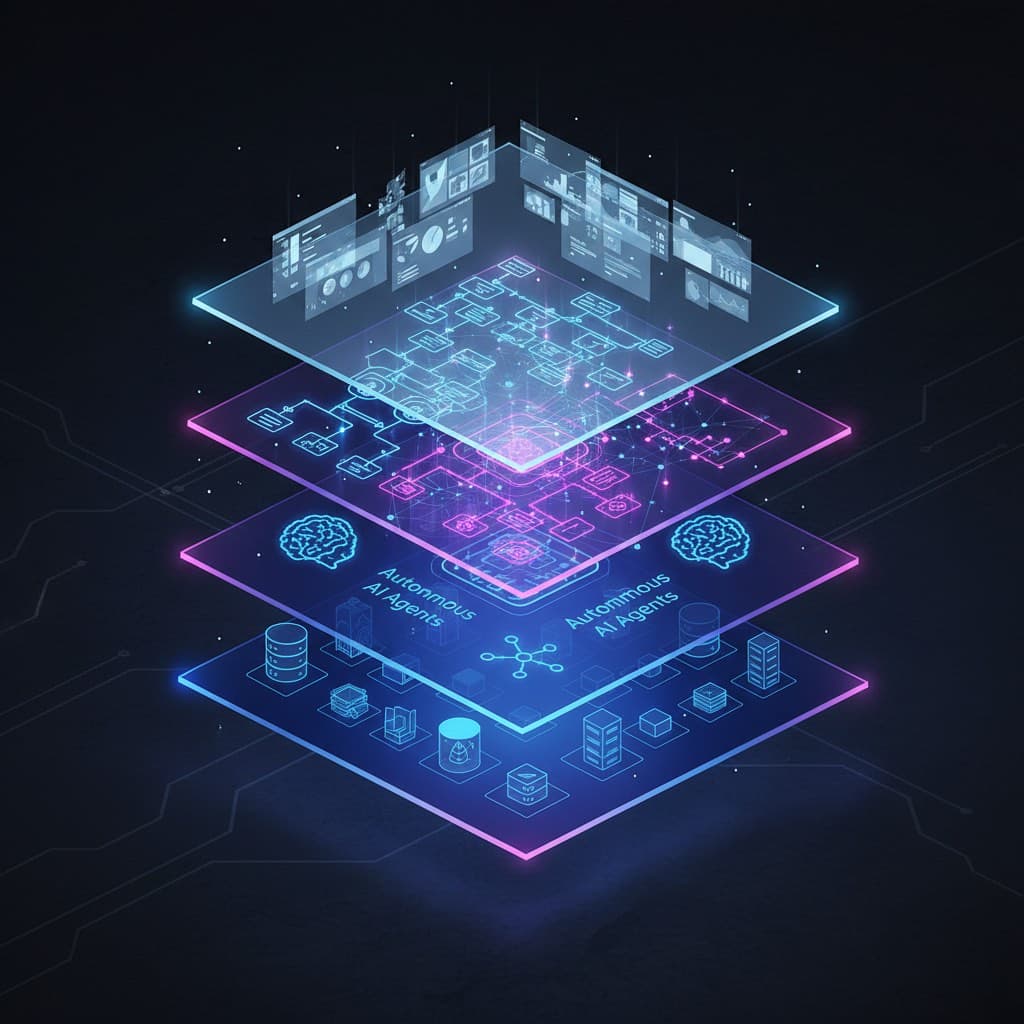
An AI operating system is a unified architecture for running a business where AI agents, not humans, are the default operators of routine work. It coordinates four layers: a shared data substrate, a pool of AI agents, an orchestration layer of workflows, and the human-facing surfaces (chat, voice, dashboards) where work gets requested or reviewed.
Think of it the way you think about macOS or iOS. macOS doesn't do anything by itself - it provides a file system, a process manager, a permissions model, and a UI. Apps run on top. An AI operating system plays the same role for a small business: it provides the substrate (data, identity, memory, scheduling) that AI agents need to actually be useful across more than one task.
That's the part most investors miss. You can buy 30 AI tools and still not have an AI OS. You have an AI OS when those tools share a memory, hand work to each other, and answer to a single command surface.
Why the Term "AI OS" Suddenly Matters
The phrase "ai operating system" has gone from a research-paper curiosity to a category investors actually search for, because the underlying components finally exist:
- Cheap inference. Frontier models cost a fraction of what they did 18 months ago.
- Stable agent runtimes. Tools like Claude Code, LangGraph, and CrewAI made agent orchestration boring (in a good way).
- MCP and tool standards. Model Context Protocol gave us a shared way to expose tools to agents.
- Voice that actually works. VAPI, Bland, and Retell crossed the "would I let this answer my phone?" threshold.
When the parts get cheap and reliable enough, people stop treating them as parts and start treating them as a platform. That platform is the AI OS.
AI OS vs. AI Tool vs. Automation Platform
| Layer | Example | What it owns |
|---|---|---|
| AI tool | ChatGPT, a Carrot chatbot | A single task |
| Automation platform | n8n, Make, Zapier | Wiring between tools |
| AI OS | A coordinated stack of data + agents + workflows + surfaces | The whole business's operating model |
An AI tool is a feature. An automation platform is plumbing. An AI OS is an operating model. It's the thing your business runs on, not a thing your business uses.
The Four Pillars of an AI Operating System
Every AI operating system I've built or audited has the same four pillars. Skip one, and the whole thing wobbles.
Pillar 1: Data
The data layer is the AI operating system's long-term memory. It's where every lead, call transcript, contract, comp, and Slack message ends up so that any agent (or human) can answer the question "what do we know about this seller?"
In a real estate context, the data layer usually contains:
- Leads and deals (REsimpli, Podio, REIkit, or a custom Postgres schema)
- Communications (call recordings, transcripts, SMS threads, emails)
- Property data (PropStream pulls, MLS exports, county records, comps)
- Buyer side (InvestorLift buyer lists, dispo activity)
- Financials (Mercury transactions, accounting categorizations)
The key word is shared. If your CRM knows the lead's phone number, your dialer knows whether they've been called, your voice agent knows what they said last time, and your dashboard rolls all of it up - you have a data layer. If those four systems each have their own copy of the truth, you don't.
For most investors I work with, we land on a hub-and-spoke pattern: REsimpli or a Postgres warehouse as the system of record, with a thin ETL layer (n8n, Fivetran, or a Claude Code data engineer agent) keeping everything else in sync. {/* TODO: confirm typical sync latency range we quote clients */}
Pillar 2: Agents
Agents are the workforce. An agent is a model, usually Claude, GPT, or Gemini, wrapped in a goal, a set of tools, and a memory. Where a human VA is hired for a role, an agent is configured for one.
In a real estate AI OS, the agents I see most often are:
- Acquisitions agent. Outbound or inbound voice that opens conversations with sellers, qualifies them, and books the live appointment. See our AI voice agent for real estate page for what this looks like in production.
- Lead-qualification agent. SMS + email follow-up that nudges warm-but-not-hot leads over weeks and months.
- Underwriting agent. Pulls comps, runs the numbers, drafts an offer range.
- Dispo agent. Matches new contracts to the relevant buyers and drafts outreach.
- Ops agent. Categorizes transactions, drafts weekly KPI reports, flags anomalies.
Each agent has a narrow job, its own tools, and explicit hand-off rules to other agents. That last part is what separates an AI OS from a pile of chatbots: agents can call each other.
For a fuller treatment of the team metaphor, see our breakdown of AI lead generation for real estate investors, which walks through the acquisitions-to-dispo agent chain.
Pillar 3: Workflows
Workflows are how agents and humans cooperate. They define the trigger ("a new lead landed on the Carrot site"), the steps ("score it, route it to the voice agent if hot, drop it in nurture if cold"), the failure modes ("if the voice agent can't reach them in 3 attempts, hand off to a human acquisitions manager"), and the success criteria ("appointment booked in the calendar, lead status updated").
In our stack, workflows live in three places depending on complexity:
- n8n for visual, event-driven flows (new lead → enrich → score → route).
- Claude Code agents for any flow that needs reasoning ("look at this seller's history and decide what to do next").
- Cron jobs and webhooks for the boring glue.
The workflow layer is where most DIY AI projects die. Investors buy a voice agent and a CRM, the voice agent drops the lead into the CRM, and… nothing else happens. There's no workflow telling the system what next looks like. A real AI OS has dozens of small workflows quietly running, most of them invisible until something breaks.
Pillar 4: Surfaces
Surfaces are how humans interact with the AI operating system. You don't want your acquisitions manager opening five tabs to find out what happened overnight. You want them to ask, in plain English, "what changed since yesterday and what needs my attention?"
The surfaces we ship most often:
- A chat surface in Slack or a custom web app, where the team can ask the system anything and trigger work.
- A voice surface for the seller-facing side (inbound and outbound).
- A dashboard surface for KPIs that update in real time.
- A mobile surface, usually a lightweight web app, for the principal to approve offers, review transcripts, and check the pipeline from the road.
Surfaces are deceptively important. A good AI OS with bad surfaces feels like a chore. A modest AI OS with great surfaces feels like magic. Treat the chat box and the dashboard as first-class product surfaces, not afterthoughts.
Why Real Estate Investors Need an AI Operating System
Real estate investing is a low-margin, high-volume, communication-heavy business. Three traits that make an AI operating system disproportionately valuable for an REI:
An AI operating system isn't a luxury for big operators - it's the only realistic way for a small team to compete on volume. Three traits in particular:
1. The work is mostly conversation. Cold calling, SMS follow-up, inbound qualification, buyer outreach - most of an investor's headcount goes toward conversations that AI agents can now hold. {/* TODO: confirm latest VAPI sub-second latency benchmark we cite */}
2. The data is messy and federated. Most investors live across REsimpli or Podio, a dialer, a skip-trace tool, a website, a buyer list platform, and a banking app. An AI OS gives you one substrate to query across all of it.
3. The team is small and the cost of mistakes is high. A blown call with a motivated seller is a $10,000 mistake. An AI OS that makes sure nothing slips, every lead gets touched, and every contract is followed up on pays for itself in a single saved deal.
If you want the persona-specific version of this argument, our AI for wholesalers page walks through the wholesaler-specific agent stack.
What an AI OS Looks Like for a Wholesaler
Let me make this concrete. Here's a stripped-down AI operating system for a wholesaler doing 5 to 10 deals a month:
Data layer
- REsimpli as the system of record for leads and deals
- Postgres warehouse mirroring REsimpli + call transcripts + SMS history
- PropStream pulls written nightly into the warehouse
Agents layer
- Acquisitions voice agent (VAPI) for outbound + inbound
- SMS qualification agent (Customer.io + Claude) for nurture
- Underwriting agent (Claude Code) that drafts an offer range per lead
- Dispo agent that matches contracts to the buyer list and drafts outreach
Workflows layer
- New lead → enrich → score → route to voice agent or nurture
- Voice agent appointment booked → calendar invite → SMS confirmation 24h before
- Contract signed → dispo agent triggers buyer outreach within 60 seconds
- Daily cron: refresh KPIs, post a morning summary to Slack
Surfaces layer
- Slack channel where the principal can ask "what changed?" and approve offers
- Lightweight web dashboard for pipeline + KPIs
- Voice surface for seller-facing calls
That's a complete AI OS. It probably replaces three VAs, two SaaS subscriptions, and a lot of late-night Slack messages.
What an AI Operating System Looks Like for a Flipper or Landlord
The pillars stay the same; the agents change.
A flipper's AI operating system leans heavier on the underwriting agent (comps, rehab estimates, ARV) and on a project-management agent that tracks contractor draws, change orders, and timelines. Voice matters less; document processing matters more.
A landlord's AI operating system leans on a tenant communications agent (maintenance triage, rent reminders, lease renewals) and on an ops agent for reporting. Inbound voice and SMS dominate; outbound is rare.
Same four pillars. Different agents. Same operating model.
The Stack We Actually Run
I get asked all the time what we use, so here's the honest answer. We run a few different stacks for different sized investors, but the canonical one looks like this:
- Compute and orchestration: Open Claw running on a Hetzner VPS as our personal AI runtime, plus Claude Code agents for anything that needs reasoning over our codebase or data warehouse.
- Agent framework: Claude Code subagents for back-office work, VAPI for voice, n8n for visual workflows.
- Tool exposure: MCP servers for everything - REsimpli, PropStream, BigQuery, Slack, Gmail, GitHub. If an agent needs to touch a system, it touches it through MCP.
- Data: Postgres for the warehouse, BigQuery for analytics-heavy work, Customer.io for messaging history.
- Surfaces: Slack for the team chat surface, custom Next.js dashboards for KPIs, VAPI for voice.
Total monthly cost for a stack at this scale lands in the low four figures - most of it model inference and VAPI minutes. {/* TODO: refresh monthly run-rate range once Q2 invoices are in */}
The point isn't that you have to use these exact tools. The point is that every component maps cleanly to one of the four pillars. Data, agents, workflows, surfaces. If you can draw the same four-layer diagram for your business and fill in every box, you have an AI OS.
How to Start Building Your Own AI OS
You don't build an AI operating system in a weekend. But you don't need to spend a year on it either. The pattern that works:
Month 1 - Pick one pillar and one workflow. Most investors start with the agents layer and a single workflow (usually inbound voice qualification, because it's the highest-leverage and easiest to measure). Ship it. Get the data flowing into your CRM.
Month 2 - Add the data layer. Stand up a Postgres warehouse, mirror your CRM, start logging call transcripts and SMS. You don't need anything fancy. You need one place to ask questions.
Month 3 - Add a surface. Build a Slack bot or a simple web dashboard that lets you ask the system questions and trigger work. The moment your team starts using it daily, you have an AI OS.
Months 4 to 6 - Add agents one at a time. Each new agent reuses the data and surface layers you already built. Marginal cost drops with every addition.
Months 6+ - Refactor the workflow layer. By this point your AI operating system has earned its keep, and you'll know exactly which pieces need to be rebuilt. By now you'll have enough scar tissue with your AI operating system to know which flows belong in n8n, which belong in Claude Code, and which should be ripped out entirely.
If you want help compressing that timeline, that's what our AI agency for real estate investors practice exists for. We've built this stack enough times to skip most of the dead ends.
Frequently Asked Questions About AI Operating Systems
What is an AI OS in plain English?
An AI OS is the underlying stack that lets multiple AI agents work together on a shared set of data, through defined workflows, against human-friendly surfaces like chat, voice, and dashboards. It's the difference between owning a dozen AI tools and running an AI-native business.
Is an AI operating system the same as an agentic platform?
Not quite. An agentic platform (CrewAI, LangGraph, AutoGen) is one component of the agents layer. An AI OS is the broader stack, data, agents, workflows, surfaces, that an agentic platform plugs into.
Do I need to be technical to build an AI OS?
No, but you need a technical partner. The first version of your AI operating system can be assembled from off-the-shelf parts (REsimpli + VAPI + n8n + Slack) with a few hours of configuration. The second version, where it starts to feel like one system, usually needs an engineer.
How is an AI OS different from a real estate CRM?
A CRM is one node in the data layer. An AI OS is the whole stack - data plus agents plus workflows plus surfaces. A CRM that adds an AI chatbot is still a CRM; an AI OS uses a CRM (and a dozen other tools) as inputs.
How much does an AI operating system cost to run?
Wide ranges, but a credible starting stack runs $1,500 to $4,000/month all-in, mostly inference + voice minutes + SaaS. A mature stack for a multi-market operator can run $8,000 to $15,000/month and still replace 6 to 10 FTEs. {/* TODO: validate ranges against current client invoices */}
The Takeaway
Every era of business has had its operating model. Spreadsheets and email defined the 2000s. SaaS dashboards defined the 2010s. The 2020s belong to whoever figures out how to run their business as an AI operating system first.
For real estate investors, the math is straightforward. The work is mostly conversation, the data is mostly federated, and the cost of a missed lead is high. An AI OS solves all three. It's not a tool you buy - it's an architecture you adopt.
Start with one pillar. Add the next when it hurts not to. In twelve months you'll have an operating model your competitors can't replicate by buying software.
If you want to skip the dead ends, let's talk about what an AI OS looks like for your business. We do this every day.
Founder & CEO, White Space Solutions
Jason builds AI automation systems for real estate investors and business owners. With experience spanning data analytics, direct mail automation, AI voice agents, and revenue intelligence, he helps companies replace manual workflows with intelligent systems that drive measurable results.
Related Articles
The AI Operating System for Investors
The AI operating system for real estate investors is the new category. Four pillars, our reference architecture, the stack we run, and the roadmap ahead.
AI Agency for Real Estate: Buyer's Guide
How to evaluate an AI agency for real estate investing: engagement models, pricing benchmarks, red flags, and the exact questions to ask before signing.
Run Your Wholesaling Business With 3 AI Agents
How to run a real estate wholesaling business with 3 AI agents - Acquisitions, Dispo, and Ops. Daily output, cost, and the scale path I use with clients.
VA to AI Migration: 12-Month Guide
A month-by-month VA to AI migration playbook for real estate investors. Cost curves, change management, and lessons from rebuilding our team from scratch.